
By: Robert J. Nahoum
The Short Answer: Credit Cards Are Safer
Voice cloning scams are no longer science fiction, they are happening right now, and they are costing consumers thousands of dollars in unauthorized electronic withdrawals. If you have received a frantic call from someone who sounded exactly like a loved one asking for money, you are not alone.
These scams are becoming more sophisticated, and in many cases, they result in unauthorized electronic funds transfers (EFTs) from a consumer’s bank account. Fortunately, federal law, specifically the Electronic Funds Transfer Act (EFTA), provides powerful consumer protections.
What Is a Voice Cloning Scam?
Voice cloning uses artificial intelligence to replicate a person’s voice using short audio samples, often scraped from social media, voicemail greetings, or videos. Scammers then use that cloned voice to impersonate:
- A family member in distress
- A business colleague requesting urgent payment
- A bank representative or fraud department
The goal is simple: create urgency and emotional pressure so the victim quickly authorizes a transfer of funds.
These transfers often occur through:
- Zelle or other instant payment platforms
- Wire transfers
- ACH transfers initiated through online banking
Once the money is sent, victims are often told by their bank that the transaction was “authorized”, and therefore not refundable. That is not always the end of the story.
When Is a Transfer “Unauthorized” Under the Law?
The Electronic Funds Transfer Act (15 U.S.C. § 1693 et seq.) protects consumers from unauthorized electronic transfers. Under the law, an unauthorized transfer is one made without the consumer’s actual authority.
Importantly, being tricked or deceived into initiating a transfer does not automatically make it “authorized” in the legal sense.
Courts and regulators are increasingly scrutinizing situations where:
- The consumer did not intend to send money to the scammer
- The consumer was misled about the identity of the recipient
- The bank failed to detect or prevent suspicious activity
If a scammer used deception, such as a cloned voice, to induce the transfer, there may be a strong argument that the transfer was unauthorized under the EFTA.
Bank Responsibilities Under the EFTA
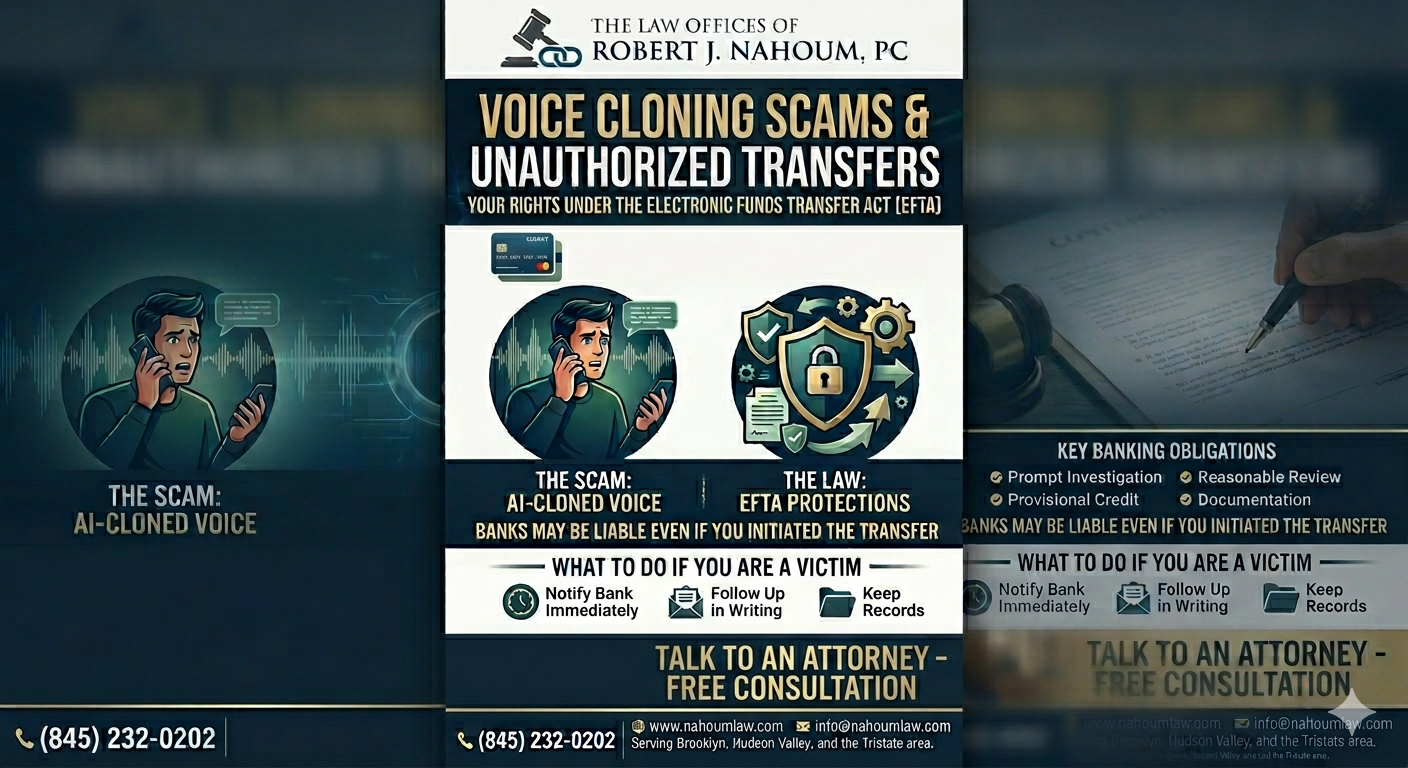
Banks have specific obligations when a consumer reports an unauthorized transfer:
- Promptly investigate the claim
- Provisionally credit the account within 10 business days (in many cases)
- Conduct a reasonable investigation, not a superficial denial
- Provide documentation supporting any denial
Too often, banks deny claims by simply stating that the transaction was “authorized” because the consumer initiated it. That is not sufficient under federal law.
If your bank failed to properly investigate your claim, you may have legal recourse.
What To Do If You Are a Victim
If you suspect you were targeted by a voice cloning scam, act quickly:
- Notify your bank immediately
- Follow up in writing to preserve your rights
- Request documentation of the bank’s investigation
- Keep records of all communications
Timing matters. Delays in reporting can affect your rights under the EFTA.
How These Cases Are Evolving
Voice cloning scams raise new legal questions, but they fit squarely within the broader framework of unauthorized electronic transfers. Financial institutions are being forced to confront:
- Whether consumer “authorization” obtained through deception is valid
- Whether fraud detection systems are adequate
- Whether denial practices comply with federal law
As these cases develop, consumers should not assume that a bank’s initial denial is the final word.
Speak With an Attorney
If your claim was denied or you lost money due to a voice cloning scam, you may have rights under federal law. An experienced consumer protection attorney can evaluate whether the transfer qualifies as unauthorized and whether the bank complied with its legal obligations.
Have You Been a Victim of Unauthorized Transfers?
If your bank has refused to reimburse you for unauthorized electronic fund transfers, or if you have lost money due to a delayed report, you may have rights under the EFTA and Regulation E. Banks sometimes wrongfully deny claims, miss investigation deadlines, or incorrectly calculate liability limits.
At The Law Offices of Robert J. Nahoum, PC, we focus on holding financial institutions accountable. We represent consumers in disputes involving:
- Unauthorized debit card charges
- Hacked online banking accounts
- Failure to provisionally credit funds
- Violation of Regulation E investigation timelines
Contact us today for a free consultation to discuss your case. We also invite you to learn more about our Consumer Protection practice area.
Protecting Consumers Against Financial Deception
If you need help recovering money lost to an impersonation scam, contact us today to see what we can do for you. With offices located in Brooklyn and the Hudson Valey, the Law Offices of Robert J. Nahoum represents consumers in cases throughout the Tristate area including New Jersey.
The Law Offices of Robert J. Nahoum, P.C
(845) 232-0202
www.nahoumlaw.com
info@nahoumlaw.com
Disclaimer: This blog post is for informational purposes only and does not constitute legal advice. Laws and regulations are subject to change. Please consult with an attorney for advice regarding your specific situation.