
By: Robert J. Nahoum
SIM swapping scams are rapidly becoming one of the most dangerous forms of financial fraud in the United States. These scams can give criminals full access to your bank accounts, often leading to devastating unauthorized electronic funds transfers.
If you have experienced this type of fraud, federal law—specifically the Electronic Funds Transfer Act (EFTA)—may provide powerful protections and a path to recover your money.
What Is a SIM Swapping Scam?
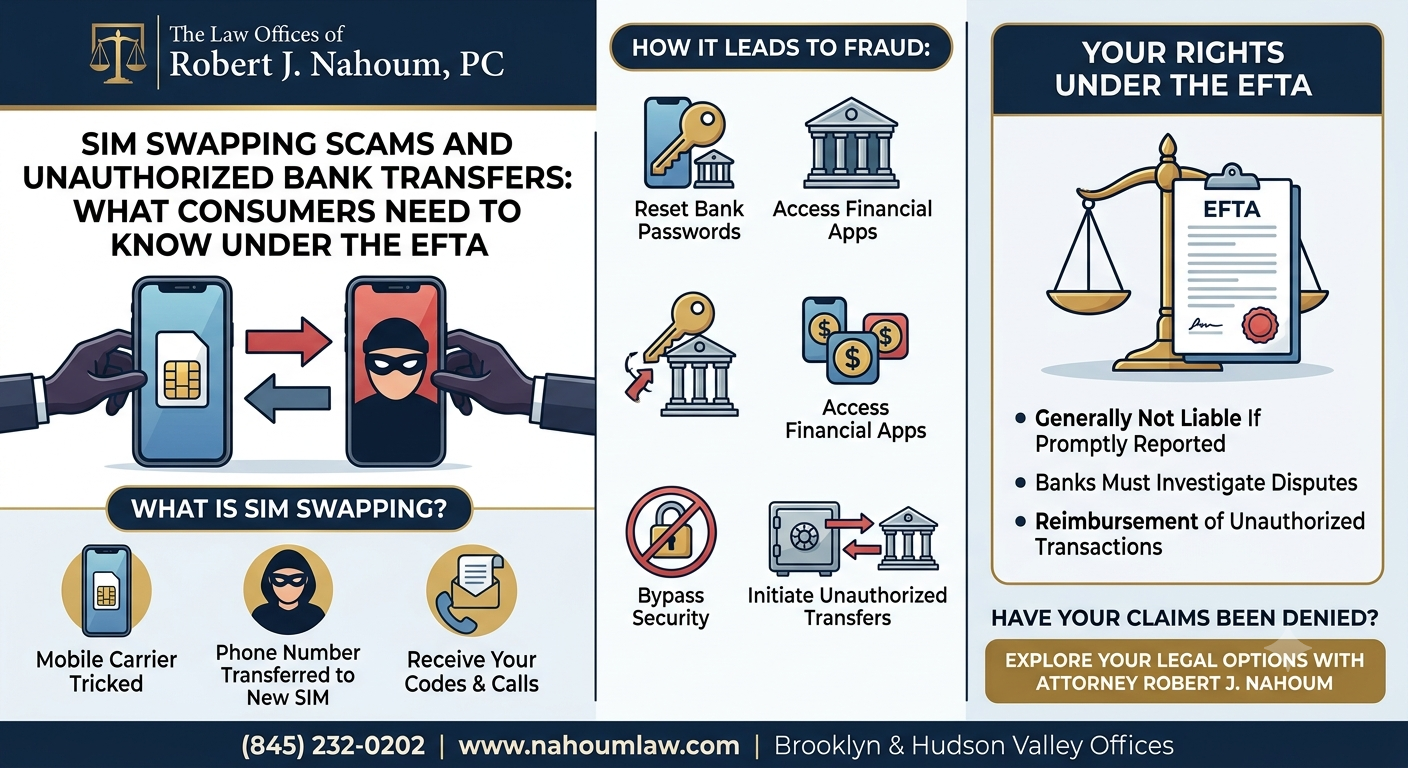
A SIM swapping scam occurs when a fraudster tricks your mobile carrier into transferring your phone number to a new SIM card that they control. Once this happens, the scammer can receive your calls and text messages, including security codes used for two-factor authentication.
With control of your phone number, the scammer can:
- Reset passwords for your bank accounts
- Access email and financial apps
- Bypass security protections tied to your phone
- Initiate unauthorized transfers or withdrawals
In many cases, victims only realize something is wrong after their phone loses service—by then, significant financial damage may already be done.
How SIM Swapping Leads to Unauthorized Transfers
Once a scammer gains access to your accounts, they often move quickly. Common tactics include:
- Initiating ACH transfers to external accounts
- Sending money through peer-to-peer apps like Zelle or Venmo
- Wiring funds out of your account
- Draining linked investment or retirement accounts
These transactions are typically classified as electronic funds transfers under federal law.
Your Rights Under the EFTA
The Electronic Funds Transfer Act (15 U.S.C. § 1693 et seq.) protects consumers from unauthorized electronic fund transfers.
Under the EFTA:
- You are generally not liable for unauthorized transfers if you report them promptly
- Banks must investigate disputes within specific timeframes
- Financial institutions must reimburse unauthorized transactions if they cannot prove authorization
Importantly, many banks attempt to deny claims in SIM swapping cases by arguing that the transaction was “authorized” because the correct login credentials or authentication codes were used. This argument is often legally flawed.
If a scammer gained access through fraud, deception, or security failures, the transfer may still qualify as unauthorized under the law.
Common Issues in SIM Swap EFTA Claims
SIM swapping cases often involve disputes over how the fraud occurred and who is responsible. Key issues include:
- Whether the bank’s security procedures were reasonable
- Whether the consumer provided timely notice
- Whether the transaction truly qualifies as “authorized”
- The role of the mobile carrier in enabling the scam
Banks may rely heavily on internal logs or automated systems, but these do not always reflect what actually happened.
What To Do If You Are a Victim
If you suspect a SIM swapping scam, immediate action is critical:
- Contact your bank and report unauthorized transactions
- Notify your mobile carrier and secure your number
- Change passwords for all financial and email accounts
- Document all communications and account activity
- File a police report
You should also consider speaking with an attorney experienced in EFTA claims. Legal representation can be especially important if your bank denies your claim or delays reimbursement.
How Legal Representation Can Help
EFTA cases involving SIM swapping scams can be complex. A lawyer can:
- Evaluate whether the bank violated federal law
- Challenge improper denial of your claim
- Pursue recovery of your funds, damages, and attorney’s fees
- Handle communications with financial institutions
If you are dealing with unauthorized electronic transfers, you may have stronger rights than your bank is willing to acknowledge.
Final Thoughts
SIM swapping scams are sophisticated, fast-moving, and increasingly common—but consumers are not without protection. The EFTA provides a powerful framework for holding financial institutions accountable when unauthorized transfers occur.
If your bank has denied your claim or failed to investigate properly, it may be worth exploring your legal options.
Protecting Consumers From Unauthorized Transfers
If you need help recovering money lost to unauthorized electronic fund transfers, contact us today to see what we can do for you. With offices located in Brooklyn and the Hudson Valey, the Law Offices of Robert J. Nahoum represents consumers in cases throughout the Tristate area including New Jersey.
The Law Offices of Robert J. Nahoum, P.C
(845) 232-0202
www.nahoumlaw.com
info@nahoumlaw.com
Disclaimer: This blog post is for informational purposes only and does not constitute legal advice. Laws and regulations are subject to change. Please consult with an attorney for advice regarding your specific situation.