By: Robert J. Nahoum
Buying a vehicle is often one of the largest financial commitments a consumer makes. When you step onto a New Jersey dealership lot, you expect a fair deal and transparent terms. Unfortunately, deceptive sales tactics and hidden auto financing schemes remain widespread across the state.
When crooked car dealerships manipulate financing terms, pad contracts, or mislead buyers, federal law steps in. The Truth in Lending Act (TILA) is a powerful federal consumer protection statute that guards car buyers against deceptive auto financing practices.
If you suspect you were ripped off by a dealership, understanding how TILA works, and recognizing common dealer fraud schemes, can help you enforce your legal rights and recover your damages.
What Is the Truth in Lending Act (TILA)?
Enacted by Congress under Regulation Z, TILA requires lenders and automobile dealers to provide clear, standardized, and accurate written disclosures about the cost of consumer credit before you sign a financing agreement.
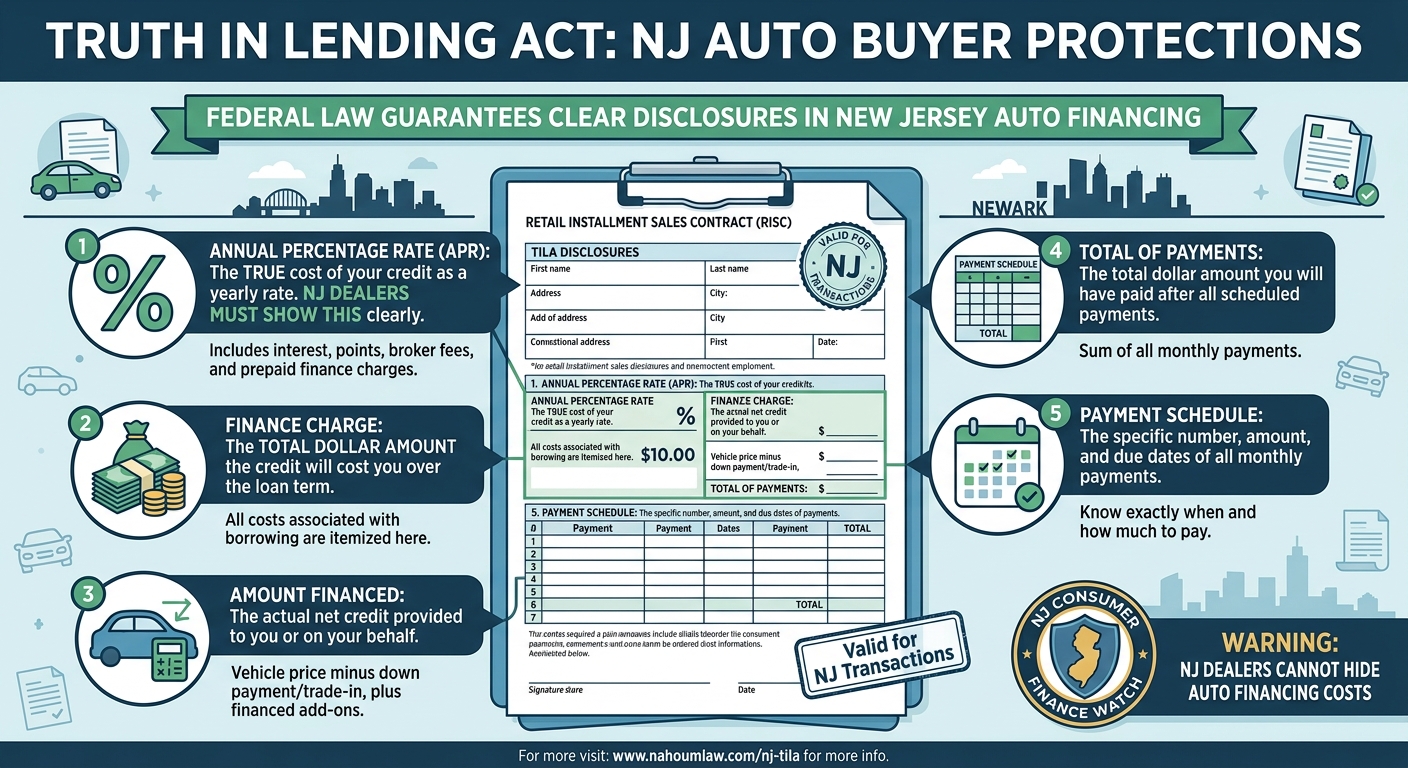
Rather than letting dealers hide costs in fine print or jargon, TILA forces dealers to display critical terms prominently in a clear “TILA Disclosure Box” on your Retail Installment Sales Contract (RISC).
Under TILA, every New Jersey auto financing contract must clearly break down:
- Annual Percentage Rate (APR): The total yearly cost of your credit, expressed as a percentage.
- Finance Charge: The total dollar amount the credit will cost you, including interest, mandatory fees, and prepaid charges.
- Amount Financed: The actual net credit provided to you (the price of the vehicle minus down payments/trade-in value, plus financed add-ons).
- Total of Payments: The total dollar amount you will have paid after making all scheduled payments.
- Payment Schedule: The specific number, amount, and due dates of all monthly payments.
When a New Jersey car dealer misrepresents these figures, omits mandatory costs, or alters the numbers after you leave the lot, they violate federal law.
Common Auto Fraud Schemes That Violate TILA in New Jersey
Auto dealers use several recurring schemes to artificially inflate loan amounts and trick buyers into unfair credit terms. Here are some of the most common auto financing fraud schemes that violate the Truth in Lending Act:
- “Yo-Yo” Financing and Spot Delivery Schemes
In a spot delivery scheme, the dealer lets you drive the vehicle off the lot before final loan approval. Days or weeks later, the dealer calls you back claiming your financing “fell through” and forces you to sign a new contract with a higher APR, a larger down payment, or worse terms. Under TILA, failing to disclose final, binding terms upfront or altering credit terms post-sale may violate consumer disclosure requirements.
- Payment Packing and Unexplained Add-Ons
Finance managers frequently “pack” monthly payments by slipping non-optional warranties, service contract, GAP insurance, paint protection, or tire plans into the loan without the buyer’s consent. When dealers present a total monthly figure without itemizing required fees versus optional add-ons, the TILA “Finance Charge” and “Amount Financed” disclosures become inaccurate and misleading.
- Interest Rate Markups and “Buy-Rate” Concealment
When a lender approves a buyer for a specific interest rate (the “buy rate”), unethical dealers frequently add an undisclosed markup (e.g., inflating a 5% approved rate to 8%) to profit off the difference. While rate markups are not inherently illegal, disguising dealer markups as non-negotiable government or lender charges may violate federal transparency mandates.
- Undisclosed Mandatory Fees Included in the Amount Financed
Dealers sometimes pad contracts with fake administrative fees, “document prep” charges, or delivery fees that are actually part of the cost of credit. Under TILA, if a fee is required to obtain credit, it must be properly classified in the Finance Charge box rather than buried in the principal Amount Financed.
- Deferred Down Payment Trickery (“Pick-Up Payments”)
If a dealer allows you to split a down payment across future dates, TILA requires specific disclosure handling. Misclassifying deferred down payments to make loan approvals look stronger to banks distorts the payment schedule and may violate TILA disclosures.
Combining Federal TILA Protections with New Jersey State Law
The Truth in Lending Act works alongside powerful state-level consumer protections. In New Jersey, victims of dealer fraud often have overlapping claims under the New Jersey Consumer Fraud Act (NJCFA), one of the strongest state statutes in the nation.
When a dealership commits a TILA disclosure violation that also involves deceptive sales practices, consumers may be entitled to:
- Statutory Damages & Rescission: Canceling the financing agreement or recovering monetary statutory penalties.
- Treble (Triple) Damages: Under the NJCFA, courts can award three times your actual financial losses for unconscionable commercial practices.
- Attorney’s Fees & Costs: TILA and NJCFA feature fee-shifting provisions, meaning the wrongdoing dealership can be required to pay your legal fees.
What to Do If You Were Ripped Off by a New Jersey Auto Dealer
If you suspect a New Jersey car dealership altered your contract, packed your loan with unauthorized fees, or misrepresented your financing terms, do not wait:
- Gather Your Paperwork: Keep every draft, buyer’s order, window sticker (Monroney label), finance contract, and text message from the transaction.
- Compare Your Disclosures: Look closely at the TILA box on your Retail Installment Sales Contract. Compare the figures against your initial quotes and finance estimates.
- Consult a Consumer Protection Attorney: Fighting an auto dealership on your own can be overwhelming. An experienced lawyer can audit your finance contract for hidden statutory violations.
At The Law Offices of Robert J. Nahoum, P.C., we regularly represent consumers who have been ripped off by New Jersey auto dealers. If you faced deceptive practices, auto loan manipulation, or unfair contract terms, visit our Auto Fraud Legal Services page to learn how we hold dishonest car dealerships accountable.
For more information about consumer rights and deceptive business practices, visit our consumer protection practice page and our auto-fraud articles.
At The Law Offices of Robert J. Nahoum, P.C., we represent New York and New Jersey consumers who have been ripped off by dishonest auto dealers. If your deal doesn’t match what was promised, you have rights—and we can help you enforce them.
For a free consultation about an auto‑fraud or deceptive‑sales issue, contact us at our Hudson Valley office or our Brooklyn location.
📞 Call (845) 232‑0202 or visit our contact page: www.nahoumlaw.com/contact