
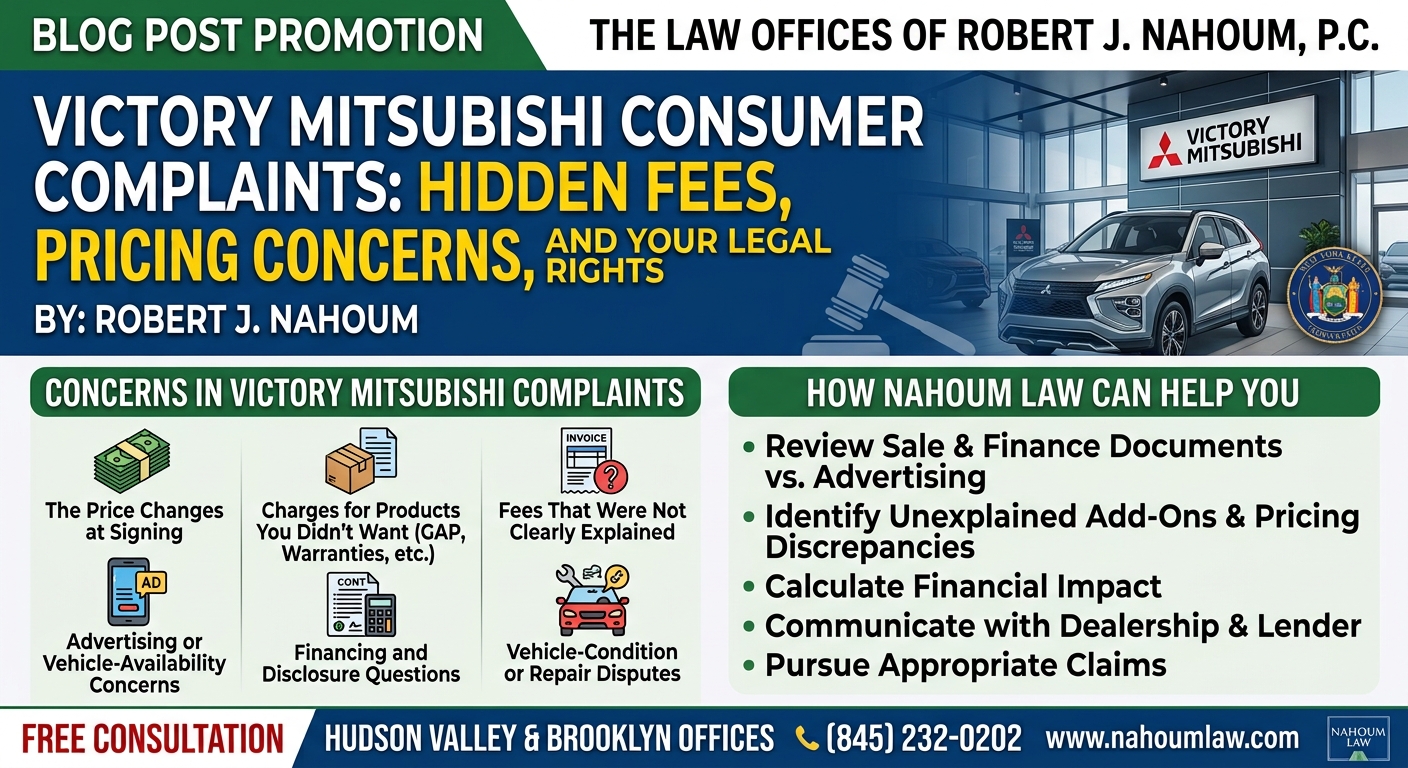
Victory Mitsubishi Consumer Complaints: Hidden Fees, Pricing Concerns, and Your Legal Rights
By: Robert J. Nahoum
If you bought or financed a vehicle from Victory Mitsubishi in the Bronx and believe the deal did not match what you were promised, do not assume the paperwork ends the conversation. A careful review of the advertising, sales documents, finance contract, and communications may identify important questions about your rights.
The Law Offices of Robert J. Nahoum, P.C. represents New York consumers in auto-fraud and deceptive-business-practices matters. This article discusses concerns that consumers may report in vehicle transactions and the laws that may apply. It does not determine whether Victory Mitsubishi, or any other dealer, engaged in unlawful conduct in a particular sale. That depends on the particulars of your case and the specific evidence.
CONCERNS IN VICTORY MITSUBISHI COMPLAINTS
The price changes at signing
A buyer may see an advertised or negotiated price, then learns in the finance office that the vehicle will cost more because of fees, add-ons, down-payment requirements, or financing conditions.
Charges for products the buyer did not want
Buyers sometimes find charges for products they say they did not request or knowingly approve. Examples may include anti-theft products, service contracts, warranties, GAP coverage, paint or fabric protection, tire-and-wheel coverage, etching, appearance packages, or other aftermarket items.
Fees that were not clearly explained
A buyer’s order or retail installment contract may include unfamiliar charges. The key questions are what the charge was, whether it was optional, how it was disclosed, and whether the buyer agreed to it.
Advertising or vehicle-availability concerns
A buyer may be drawn to a dealership by an online price or a particular vehicle, only to be told that the price or vehicle is unavailable or that additional conditions apply. The advertising, screenshots, and communications matter.
Financing and disclosure questions
A buyer may question whether the monthly payment, APR, finance charge, amount financed, loan term, required down payment, or optional products were accurately explained and reflected in the final contract.
Vehicle-condition or repair disputes
Used-car buyers may have concerns about prior damage, accident history, mechanical condition, promised repairs, warranties, or statements made during the sale.
LAWS THAT MAY APPLY
The facts of a particular transaction determine which laws apply and whether a viable claim exists. Depending on the evidence, a New York auto-dealer matter may involve the following:
New York General Business Law § 349: Deceptive Business Practices
New York General Business Law § 349 prohibits deceptive acts and practices in business. A consumer injured by a deceptive act or practice may seek actual damages or $50, whichever is greater. A court may increase damages for a willful or knowing violation, up to the statutory limit, and may award reasonable attorney’s fees to a prevailing plaintiff.
New York General Business Law § 350: False Advertising
New York General Business Law § 350 prohibits false advertising in business. It may be relevant when advertising, online listings, quoted prices, or promotional representations are materially misleading.
Truth in Lending Act (TILA)
For auto loans, federal law requires disclosures that include the amount financed, finance charge, annual percentage rate, total of payments, and payment schedule, as applicable. Whether a particular dealer or lender is legally responsible for a disclosure issue depends on the transaction and the parties’ roles.
New York Motor Vehicle Retail Instalment Sales Act
Similar to the Truth in Landing Law, New York law requires a motor-vehicle retail installment contract to be in writing, contain all agreements of the parties, and be signed by both buyer and seller. The statute also includes content, disclosure, copy-delivery, and other requirements.
Depending on the circumstances, common-law fraud, breach of contract, warranty law, and other state or federal claims may also be considered. An attorney should evaluate the paperwork, representations, timeline, and actual financial harm before drawing conclusions.
WHAT TO SAVE IF YOU BELIEVE THE DEAL WAS MISLEADING
If you believe Victory Mitsubishi misled you, hold on to your evidence before it disappears. Keep copies of:
- Online listings, advertisements, screenshots, emails, and text messages showing the advertised price and terms.
- The buyer’s order, bill of sale, retail installment contract, delivery paperwork, add-on forms, warranty documents, and insurance or GAP paperwork.
- Down-payment receipts, trade-in records, bank statements, and payment records.
- The names of dealership employees involved and a written timeline of what was said before and during the sale.
- Photos, repair records, vehicle-history reports, and communications concerning the vehicle’s condition or promised repairs.
Do not sign a replacement contract, cancellation agreement, release, or “corrected” document without understanding how it could affect your evidence and rights.
FREQUENTLY ASKED QUESTIONS ABOUT VICTORY MITSUBISHI COMPLAINTS
Can a car dealer add fees after advertising a price?
The answer depends on what the advertisement said, whether any qualifications were clear, and what occurred during the sale. Save the advertisement, screenshots, and all paperwork so the transaction can be evaluated.
What documents should I bring to an auto-fraud lawyer?
Bring the buyer’s order, retail installment contract, bill of sale, add-on forms, warranty or GAP documents, advertisements, financing communications, down-payment records, and a written timeline of what happened, text messages, screen shots, emails and copies of any other communications.
Can I challenge charges for dealer add-ons I did not want?
Potentially. The important questions include whether the product was optional, what you were told, what you signed, whether it was included in the contract, and the financial impact. A document review can help answer those questions.
HOW NAHOUM LAW CAN HELP
The Law Offices of Robert J. Nahoum, P.C. helps consumers assess whether a vehicle transaction involved deceptive practices, unauthorized products, false advertising, or unlawful financing disclosures. Our firm can:
- Review the sale and finance documents against the advertising and promises that brought you to the dealership.
- Identify unexplained add-ons, pricing discrepancies, and disclosure issues.
- Calculate the financial impact of dealer fees, unwanted products, and financing terms.
- Communicate with the dealership, lender, and warranty or service-contract provider.
- Pursue appropriate claims for restitution, damages, attorney’s fees, rescission-related relief where available, or other remedies.
For more information about consumer rights and deceptive business practices, visit our consumer protection practice page and our auto-fraud articles. If you have a Victory Mitsubishi complaint, bring your complete sales and financing file to the Law Offices of Robert J. Nahoum, P.C. for an individualized evaluation.
At The Law Offices of Robert J. Nahoum, P.C., we represent New York and New Jersey consumers who have been ripped off by dishonest auto dealers. If your deal doesn’t match what was promised, you have rights—and we can help you enforce them.
For a free consultation about an auto‑fraud or deceptive‑sales issue, contact us at our Hudson Valley office or our Brooklyn location.
📞 Call (845) 232‑0202 or visit our contact page: www.nahoumlaw.com/contact