
By: Robert J. Nahoum
Have you ever found a vehicle advertised online for $25,000, only to sit down at the dealership and watch the final figure balloon to $29,000 after mandatory “doc fees,” prep costs, and unwanted dealer add-ons?
If so, you are not alone. Deceptive “bait-and-switch” pricing is one of the most common ways consumers get taken advantage of when buying a car.
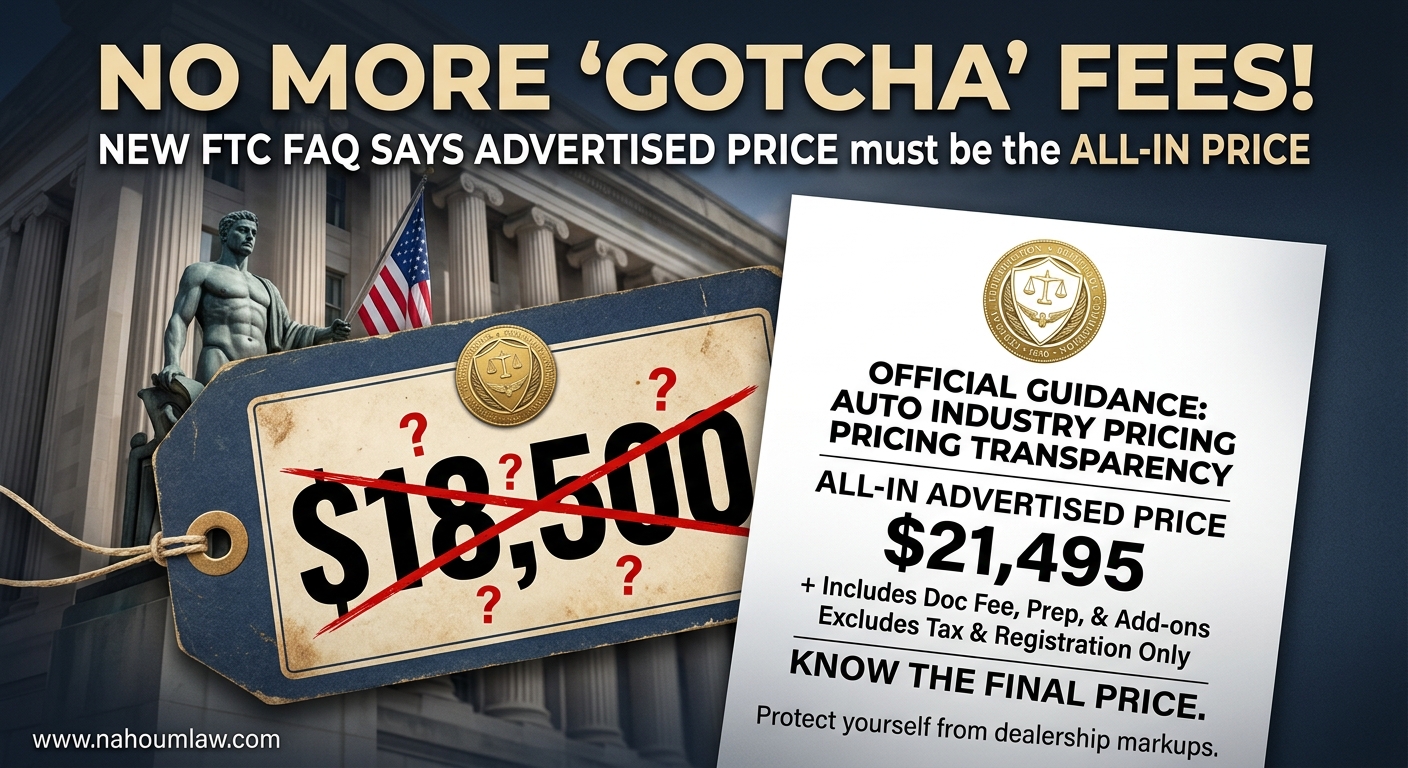
To crack down on these deceptive practices, the Federal Trade Commission (FTC) issued comprehensive guidance titled Automobile Industry Pricing Transparency: FAQs. This clarification sends a firm warning to car dealerships across the nation: the advertised price must be the actual “all-in” price any buyer can walk in and pay.
As a consumer protection lawyer who routinely represents car buyers fighting back against unscrupulous auto dealer practices, I view this guidance as a critical tool for consumer awareness. Here is what you need to know about the FTC’s announcement, followed by a direct reprint of the official FAQs.
Background: Why the FTC Issued This Pricing Transparency Guidance
For years, the FTC has tackled junk fees and bait-and-switch schemes in auto sales under Section 5 of the FTC Act, which bans unfair or deceptive acts or practices.
When car dealers advertise a low baseline price to lure customers onto the lot, only to tack on non-negotiable fees right before you sign the contract, it prevents true comparison shopping and unfairly penalizes honest dealerships.
The FTC’s primary rules regarding dealer pricing disclosures establish key protections:
- All-In Pricing: Advertised prices must include all mandatory fees (e.g., documentation fees, dealer prep fees, destination charges). The only charges that can be excluded from the advertised figure are mandatory government charges like state sales tax, title, and registration fees.
- Prominence: The “all-in” price must be the most prominent figure shown in any advertisement—whether on a website listing, print ad, or social media post.
- No Hidden Conditional Discounts: Dealers cannot advertise a price that reflects conditional rebates unless every customer qualifies for them. For instance, a military discount cannot be baked into the baseline advertised price.
- No Deceptive Add-ons: Dealers cannot claim optional accessories or protection packages are required by law or mandatory, nor can they charge for products without express, informed consent.
If you suspect you have been tricked by unexpected dealer markups or mandatory add-on products during a vehicle purchase, you can read more about your legal rights on our auto dealer fraud practice page.
Direct Reprint: FTC Automobile Industry Pricing Transparency FAQs
Below is the official text released by the Federal Trade Commission:
- Why is the FTC focused on price transparency?
One of the FTC’s enforcement priorities is ensuring that advertised pricing is transparent and truthful. When consumers do not know the true price of any product, including cars, the consequences are felt across the marketplace.
The FTC’s focus on price transparency is driven by the evidence and complaints we see every day in the marketplace: when the price a consumer sees in an ad is not the price they will actually pay, the entire shopping experience breaks down. A consumer might walk onto a car lot expecting one price, only to learn after investing time, arranging transportation, or even negotiating, that the real cost is hundreds or thousands of dollars higher. That kind of surprise does not just frustrate the individual buyer; it distorts the broader market. Consumers lose the ability to comparison-shop. They cannot make informed decisions because they are evaluating prices that do not reflect reality. And legitimate dealers trying to compete honestly for consumers’ business by advertising truthful, all-in prices are unfairly disadvantaged by competitors willing to advertise artificially low numbers that no customer can actually obtain.
The result is a marketplace that cannot function efficiently. That is why the FTC is committed to ensuring that the price consumers see in advertising is the actual price they will pay, aside from required government charges like taxes. That commitment flows directly from the FTC Act, which prohibits deceptive or unfair acts or practices. Although every advertisement is ultimately assessed on its specific facts, certain long-standing principles apply. These FAQs reflect staff’s views and explain how the FTC Act governs pricing practices so that consumers can trust the prices they see, and legitimate businesses can compete on a level playing field.
- What needs to be included in the advertised price, and what can be left out?
When a consumer sees a price in a car advertisement, they reasonably expect that number to reflect what they will actually have to pay when they walk onto the lot. When additional fees or charges are required by the dealer and added to the final cost but consumers discover them only after investing time, sitting through negotiations, or even preparing to sign paperwork, that’s a problem. That kind of surprise not only frustrates buyers, it distorts the competitive landscape: dealers who advertise artificially low prices gain an unfair edge over those who truthfully advertise what a car really costs.
That is why the FTC Act requires that the advertised price be the actual price any consumer can walk in and pay. In other words, if a dealer requires a consumer to pay a fee to purchase the car, that fee must be included in the advertised price. Dealers may exclude government-required charges, i.e., amounts a Federal, State, or local government agency requires the consumer to pay directly. As explained in more detail below, everything else must be included in the advertised price. This includes dealer-required fees that governments authorize but do not mandate, and fees the government requires the dealer to pay but that the dealer passes onto consumers. The goal is simple: to ensure that the advertised price reflects reality. That way, consumers can comparison-shop with confidence, and honest dealers can compete fairly on transparent, all-in pricing.
Key Takeaways for Auto Shoppers
When shopping for a new or used vehicle, keep these core practical tips in mind:
- Take Screenshots of Online Pricing: Always take a clear screenshot or printed copy of the vehicle listing online showing the advertised price before visiting the dealership.
- Inspect the Sales Contract Carefully: Verify that mandatory “document fees,” processing fees, or prep charges were included in the price quoted in the advertisement.
- Reject Unwanted Add-ons: Items like GAP insurance, extended warranties, window etching, or fabric protection cannot be forced upon you as mandatory purchase conditions unless explicitly included in the advertised baseline price.
Ripped Off by an Unscrupulous Auto Dealer? We Can Help.
If an auto dealership charged you fees above their advertised price, slipped hidden charges into your financing paperwork, or engaged in unlawful pricing schemes, you have legal options. Federal and state laws provide strong protections against auto dealer fraud.
How The Law Offices of Robert J. Nahoum, P.C. Can Help
At The Law Offices of Robert J. Nahoum, P.C., we represent consumers who have been ripped off by deceptive auto dealers across New Jersey and New York. Because state and federal laws contain fee-shifting provisions, holding dishonest car dealerships accountable often costs consumers nothing out-of-pocket.
Contact our office today for a free case evaluation.
- Phone: (845) 232-0202
- Email: info@nahoumlaw.com
- Online: www.nahoumlaw.com/contact
For a free consultation about an auto‑fraud or deceptive‑sales issue, contact us at our Hudson Valley office or our Brooklyn location.
📞 Call (845) 232‑0202 or visit our contact page: www.nahoumlaw.com/contact