
By: Robert J. Nahoum
You find the perfect car online. The price is right, the monthly payment fits your budget, and the listing says it’s sitting on the lot right now. You drive down to the dealership, excited to sign the paperwork, only to hear the salesperson say: “Oh, that car just sold an hour ago. But let me show you this other model instead.” Suddenly, you are looking at a completely different vehicle with a much higher price tag, or being told the original price was only available under impossible conditions.
If this has happened to you, you didn’t just experience bad luck—you may have been the victim of an illegal auto dealer bait and switch.
At The Law Offices of Robert J. Nahoum, PC, we represent consumers who have been ripped off by deceptive auto dealers. Here is what you need to know about how bait and switch tactics violate federal and New York consumer protection laws, and what you can do about it.
What is a Bait and Switch?
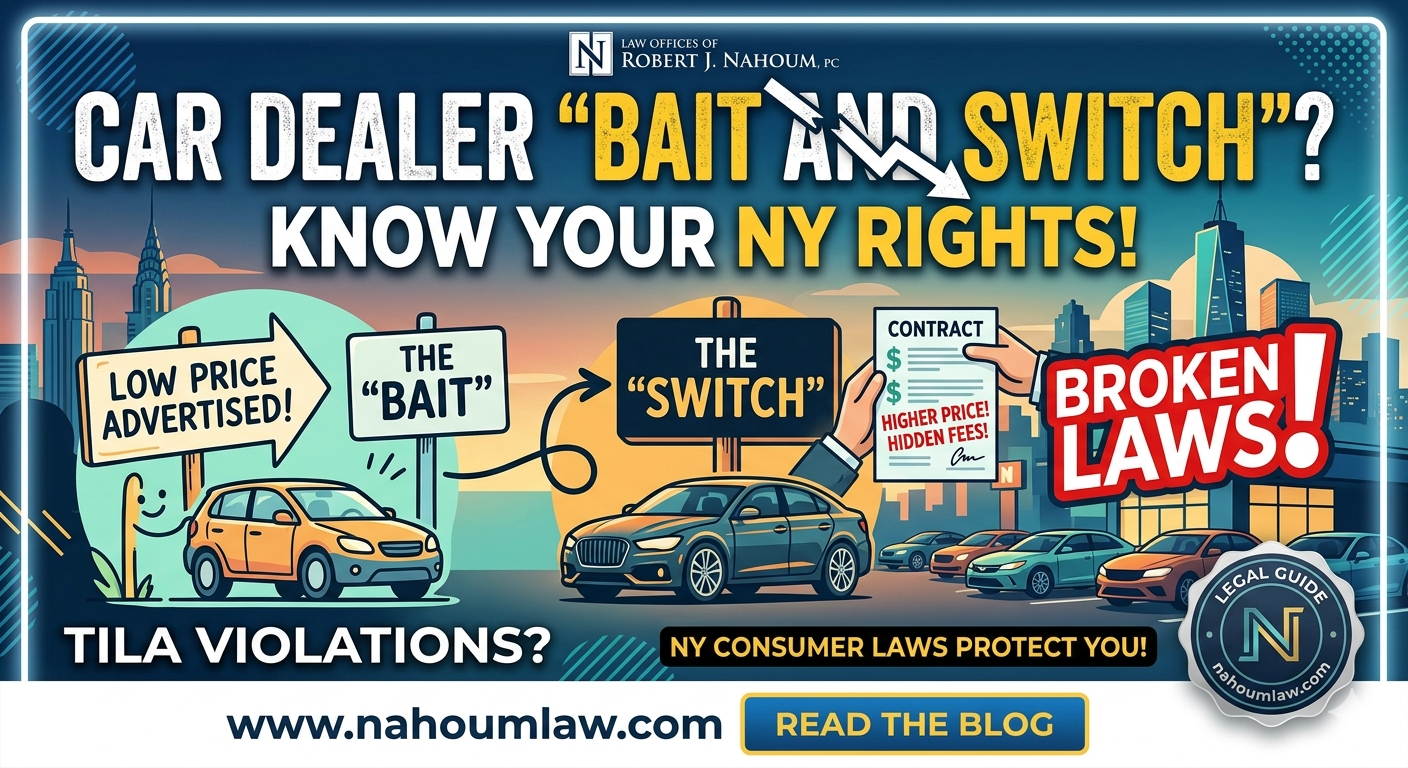
A “bait and switch” is a deceptive sales tactic where a business advertises a product or service at a highly attractive price (the “bait”) to lure customers into the store. Once the customer arrives, the business attempts to sell them a more expensive product or the same product under much less favorable terms (the “switch”).
In auto sales, this often looks like:
- Advertising a vehicle that the dealer does not actually have in stock or has no intention of selling at the advertised price.
- Refusing to show or sell the advertised vehicle.
- Claiming the advertised price was a “typo” or that it required a massive, unadvertised down payment.
- Aggressively pushing a higher-priced model or forcing you to accept expensive, unwanted add-ons (like fabric protection, extended warranties, or anti-theft etching) that inflate the final cost.
How Bait and Switch Tactics Violate Federal Law
Car dealerships are heavily regulated at the federal level. When dealers engage in dishonest advertising, they run afoul of the Federal Trade Commission (FTC) Act.
Specifically, Section 5 of the FTC Act prohibits “unfair or deceptive acts or practices in or affecting commerce.” The FTC explicitly defines bait and switch advertising as an unfair trade practice. Under federal guidelines, a dealer cannot advertise a vehicle unless they have a reasonable supply available to meet anticipated demand, or unless the advertisement clearly states that quantities are limited.
The Financing Bait and Switch: Violating the Truth in Lending Act (TILA)
The “switch” at a car dealership doesn’t just apply to the physical car—it frequently involves the financing terms. When a dealer lures you in with an advertised low monthly payment, 0% APR, or a specific down payment requirement, and then forces you into a much more expensive loan agreement, they may be violating the federal Truth in Lending Act (TILA).
TILA is a federal consumer protection law designed to ensure that credit terms are disclosed clearly and conspicuously, allowing you to meaningfully compare credit costs. In an auto dealer bait and switch scenario, TILA is typically implicated in two ways:
- Deceptive “Triggering Terms” in Advertising
Under TILA and its regulatory framework (Regulation Z), if an auto dealer advertises specific financing details—known as “triggering terms”—they are legally required to disclose other important terms clearly and conspicuously.
- The Trigger: If an ad mentions the down payment amount, the number of payments, the monthly payment amount, or the finance charge.
- The Requirement: The dealer must also clearly state the annual percentage rate (APR), the terms of repayment (how long you will pay), and the down payment required.
If a dealer advertises an incredibly low monthly payment to get you into the showroom, but buries the fact that it requires a massive $10,000 down payment or a 96-month loan in unreadable fine print, they may have violated federal disclosure laws.
- “Yo-Yo” Financing Schemes
A common variation of the financing bait and switch is “yo-yo” financing (or spot delivery fraud). The dealer hands you the keys and tells you that you are approved at a specific, attractive interest rate. A week later, they call you back and claim, “The financing fell through. You need to come back and sign a new contract at a higher interest rate, or we will repossess the car.”
By failing to provide accurate, final cost disclosures at the time you originally signed for the vehicle, or by manipulating the financing terms after the fact, the dealership may be in direct violation of TILA.
Why TILA Violations Matter: Like New York’s consumer protection laws, a successful TILA lawsuit can force the dealership to pay statutory damages, actual damages, and your attorney’s fees. This means an auto fraud attorney can often take your case without you having to pay upfront legal fees.
Your Protections Under New York State Law
New York has consumer protection laws to shield car buyers from predatory dealership practices.
- New York General Business Law Section 350 (False Advertising)
Under New York law, false advertising is illegal. It is a violation for an auto dealer to publish misleading advertisements concerning the price, characteristics, or availability of a vehicle. If a dealer uses a low price to get you through the door with no intention of honoring it, they are violating Section 350.
- New York General Business Law Section 349 (Deceptive Practices)
This is New York’s broad consumer protection statute. It prohibits any deceptive acts or practices in the conduct of any business, trade, or commerce. A systemic bait and switch routine by a dealership is a classic example of a deceptive business practice. If you win a lawsuit under Section 349, the court can order the dealer to pay your actual damages, punitive damages, and—crucially—your attorney’s fees.
- New York DMV Regulations
The New York Department of Motor Vehicles (DMV) also regulates dealer advertising. Dealerships are legally required to include specific disclosures in their ads, such as the exact stock number of a specific vehicle if only one is available at that price. They are also barred from advertising a price that excludes standard costs other than tax, title, and registration fees.
How to Protect Yourself and Fight Back
If you suspect an auto dealer is trying to pull a bait and switch on you, take these steps immediately to protect yourself:
- Save the Advertisement: Take screenshots or print out the exact online listing, social media ad, or paper advertisement you saw. Ensure the date and the vehicle details (like the VIN or stock number) are visible.
- Keep Your Notes: Write down the names of the salespeople you spoke with, the date and time of your visit, and exactly what they told you regarding why the advertised car was unavailable.
- Don’t Sign Out of Frustration: If the deal changes from what you were promised, walk away. Do not let high-pressure sales tactics force you into a contract you don’t want.
- Contact a Consumer Protection Lawyer: You do not have to just accept being ripped off.
Get Help from a New York Consumer Rights Attorney
Car dealerships have teams of lawyers defending their practices, and they count on everyday consumers staying quiet. If you believe you were the victim of fraud, deceptive advertising, or predatory financing at a dealership, we are here to level the playing field.
Visit www.nahoumlaw.com to learn more about your rights, or contact The Law Offices of Robert J. Nahoum, PC today to schedule a consultation and find out how we can help you fight back.
At The Law Offices of Robert J. Nahoum, P.C., we represent New York and New Jersey consumers who have been ripped off by dishonest auto dealers. If your deal doesn’t match what was promised, you have rights—and we can help you enforce them.
For a free consultation about an auto‑fraud or deceptive‑sales issue, contact us at our Hudson Valley office or our Brooklyn location.
📞 Call (845) 232‑0202 or visit our contact page: www.nahoumlaw.com/contact