
By: Robert J. Nahoum
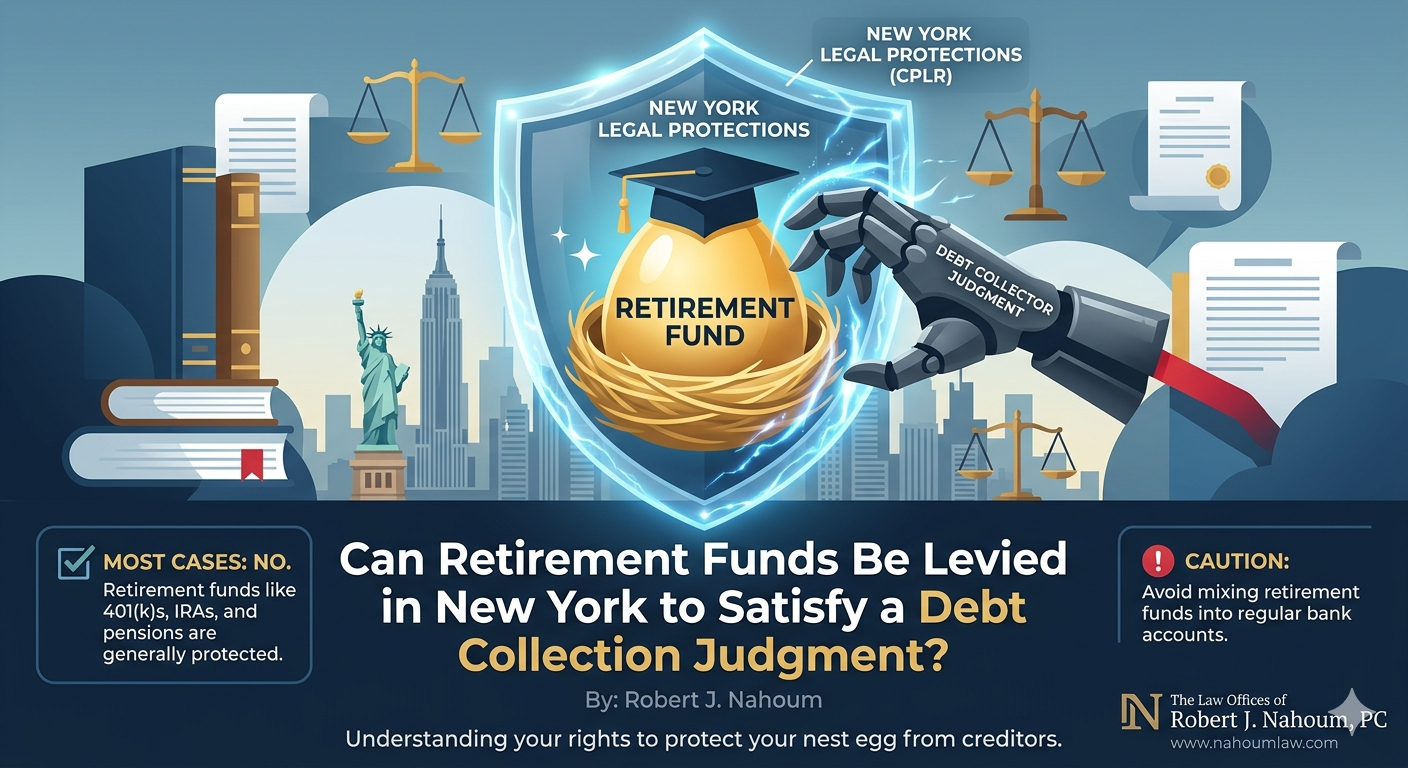
Can retirement funds be levied in New York?
In most cases, no. New York law generally protects retirement funds from judgment creditors, including many 401(k)s, IRAs, pensions, and similar retirement accounts. The key issue is usually not whether a creditor has a judgment, but whether the money is actually protected retirement money and whether it has been properly traced and exempted.
That said, protections can depend on the type of account, how the funds are held, and whether the money has been mixed into a regular bank account. Retirement funds are generally protected, but they are not always automatically exempt from collection without action by the account holder.
What New York protects
New York protects many retirement assets from collection, including funds in qualified retirement plans and IRAs. State guidance says retirement funds are protected from debt collection, and New York law also exempts certain retirement assets held in accounts or plans qualifying under the tax code.
In practical terms, this often means a creditor cannot simply take money directly from a 401(k) or IRA to satisfy a judgment. Federal law also gives strong protection to ERISA-covered employer plans such as many 401(k)s and pensions.
When creditors may still reach money
A creditor may have a better argument if retirement money has been withdrawn and deposited into a regular checking or savings account, especially if the funds are no longer clearly traceable as retirement funds. New York’s protections are strongest when the money remains in the retirement account or can still be identified as exempt retirement money.
Also, “retirement” labels can create confusion. Not every account used for long-term savings has the same legal protection, and not every source of money in a bank account is automatically exempt just because the owner is retired.
Bank levies and exemptions
If a debt collector gets a judgment, it may try to restrain or levy a bank account. New York’s exemption rules are designed to preserve certain protected funds, including retirement funds, but the account holder may need to assert those exemptions to keep the money safe.
What to do after a judgment
If you have been sued by a debt collector or already have a judgment against you, do not assume all of your money can be taken. Start by identifying where the funds are held, what type of account they are in, and whether the money is retirement money, wages, or ordinary cash.
If the collector has targeted a bank account containing protected funds, you may be able to claim an exemption and challenge the levy. This is especially important if the account contains retirement income, pensions, or other protected benefits.
How we can help
At Nahoum Law, we represent consumers facing debt collection lawsuits and regularly defend cases involving levied assets and bank accounts.
Get Your Free Consultation Today
Contact The Law Offices of Robert J. Nahoum, PC immediately.
📞 Call Us: [Insert Phone Number]
📍 Serving: all of New York State
🌐 Learn More: www.nahoumlaw.com
Disclaimer: This FAQ is for informational purposes only and does not constitute legal advice. Laws change, and every case is unique—consult a qualified New York attorney at Nahoum Law for guidance on your specific situation. Prior results do not guarantee outcomes. This is general information, not legal advice; consult an attorney for your case.