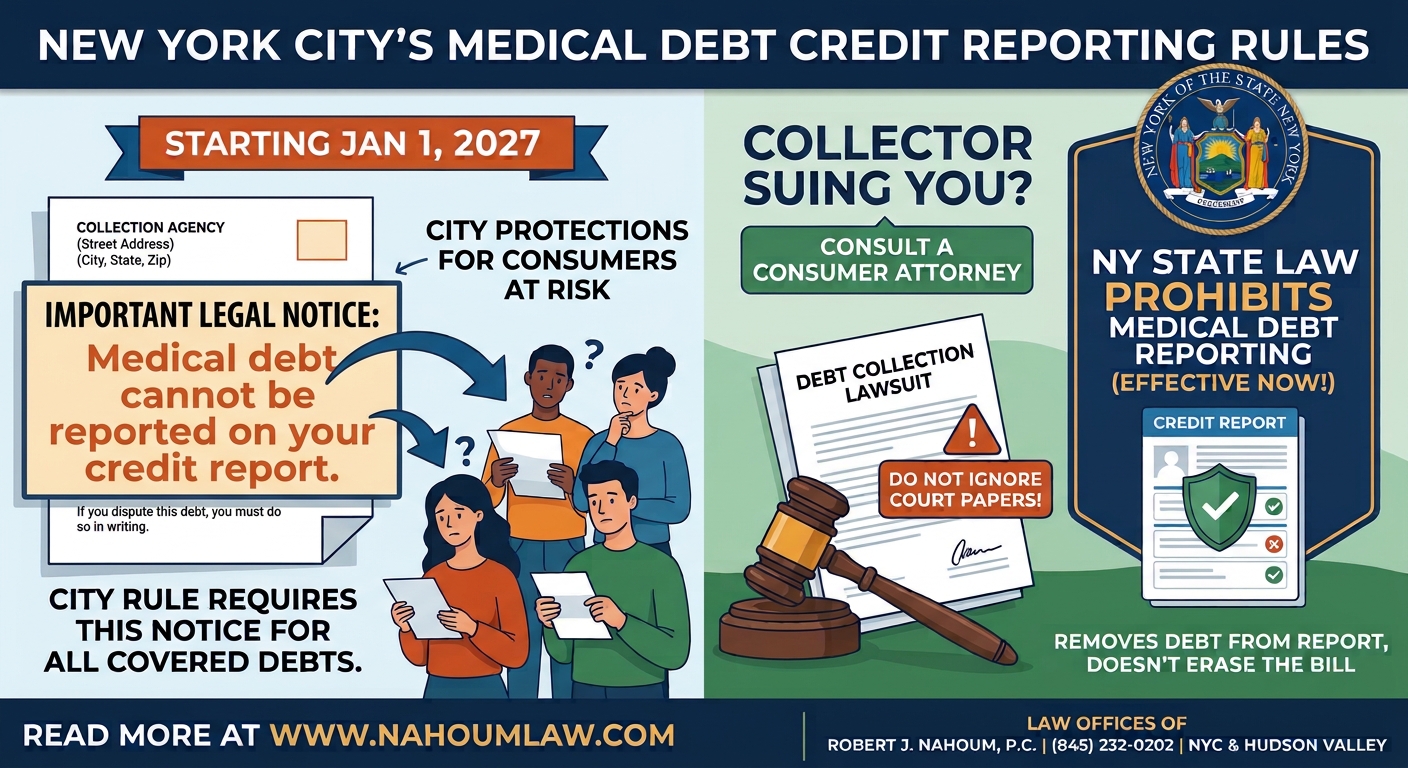
Starting January 1, 2027, debt collectors dealing with New York City consumers must include an important warning in their written debt validation notices: “Medical debt cannot be reported on your credit report.” The disclosure must appear even when the collector is pursuing a credit card balance or another nonmedical debt.
This NYC medical debt credit reporting requirement gives consumers information they may not otherwise know. But it also raises important questions: Does the rule cover everyone in New York State? Does it erase medical bills? And what should you do if a collector sues you?
The key distinction is disclosure: the new city requirement tells collectors what they must explain. Separately, New York State already has a law restricting medical debt credit reporting. Neither protection means you should ignore a collection letter or lawsuit.
What changes on January 1, 2027?
New York City’s updated debt collection rules require collectors to tell consumers, in writing, that medical debt cannot be reported to a consumer reporting agency. Those agencies are commonly called credit bureaus.
The requirement is part of the city’s SHIELD Rule, administered by the Department of Consumer and Worker Protection, or DCWP. The agency identifies January 1, 2027, as the rule’s effective date.
The disclosure belongs in a “validation notice”, the written notice that explains the debt a collector claims you owe and provides information about your rights. Under the city’s rules, collectors must mail that notice within five days of their first contact with you.
For a broader overview, see our guide to NYC’s debt collection rules and the January 2027 changes.
Why would a credit card collection letter mention medical debt?
Because the medical debt statement must appear in all covered validation notices, regardless of the type of debt being collected.
Suppose a collector writes to you about an overdue store credit card. The letter’s medical debt warning does not mean the collector has classified that account as a hospital bill. It is a required explanation of your rights.
That distinction matters. Consumers should read the warning alongside the account information, not assume that the warning changes what kind of debt the collector is pursuing.
Is this a New York City rule or a statewide protection?
There are two different protections to understand.
The new notice requirement applies to New York City consumers
The January 1, 2027, disclosure requirement is part of New York City’s debt collection rules. It should not be described as a new statewide collection-letter requirement.
New York State already restricts medical debt credit reporting
According to the New York Attorney General, the Fair Medical Debt Reporting Act took effect on December 13, 2023. It prohibits consumer reporting agencies from placing or maintaining medical debt information on a consumer’s credit report, including qualifying debt charged to a medical credit card. The Attorney General explains that the prohibition applies regardless of when the medical debt arose.
The state law also prohibits covered health care providers from reporting medical debt and requires them to include restrictions on reporting in their contracts with debt collectors.
In practical terms, the city’s new notice requirement helps bring an existing protection to consumers’ attention. A consumer outside New York City should not confuse the geographic limits of the city’s notice rule with the separate protections provided by state law.
What counts as medical debt?
Medical debt generally includes obligations related to health care services, products, or devices provided by covered hospitals, health care professionals, or ambulance services.
But how you paid the bill can make a significant difference.
- A bill owed to a covered medical provider can qualify as medical debt.
- A balance on a credit card specifically offered to pay for health care services, products, or devices can also qualify.
- A medical expense charged to an ordinary, general-purpose credit card is not treated as medical debt under the state law simply because the purchase was for health care.
For example, putting a hospital bill on your regular credit card does not automatically protect that credit card balance from appearing on your credit report. The Attorney General specifically warns consumers about this distinction.
Does keeping medical debt off a credit report erase the bill?
No. Credit reporting and the underlying obligation to pay are separate issues.
A restriction on reporting medical debt does not, by itself, cancel the bill, establish that the amount is correct, or resolve whether the provider or collector can legally collect it. Medical debt can still lead to collection disputes and, in appropriate circumstances, lawsuits.
You may have issues worth investigating, including:
- Whether insurance paid or should have paid part of the bill.
- Whether the charges are accurate.
- Whether the company collecting the debt can prove its claim.
- Whether hospital financial assistance is available.
- Whether legal restrictions or defenses affect collection.
Our article on medical debt lawsuits in New York explains why reviewing the actual claim matters, even when you believe the bill is wrong.
What should you do when a medical debt collection letter arrives?
- Save the letter and its envelope
Keep the complete notice, the envelope, and a record of when it arrived. These materials can help establish what the collector said and when it said it. Once the new requirement takes effect, they can also help document whether the required medical debt disclosure was included.
- Check the account information, not just the warning
Review the provider’s name, the amount claimed, and the treatment or account information. Compare the demand with your bills, insurance statements, and payment records. A required disclosure does not establish that the balance is accurate.
- Dispute errors and keep records
If you believe the debt is wrong, request supporting information and explain your dispute. Keeping a written copy creates a useful record.
Importantly, DCWP’s current consumer guidance for the January 2027 rules says consumers may dispute a debt or request verification at any time. Do not confuse the collector’s 60-day verification deadline with a requirement that you dispute within 60 days.
- Ask about hospital financial assistance
If the debt involves hospital services, ask whether you qualify for financial assistance. DCWP’s guidance says collectors must disclose that consumers with low or limited incomes may qualify for assistance under hospital financial assistance policies. Notify both the collector and the provider promptly if you believe assistance may apply.
- Review your credit report if medical debt appears
The New York Attorney General explains that covered medical debt should not appear on your credit report under state law. If you find an entry you believe is prohibited, preserve a copy and review the Attorney General’s guidance on reporting medical debt. Remember that an ordinary credit card balance may be treated differently.
What if the collector leaves out the required warning?
Once the requirement applies, an omitted disclosure may be a violation worth documenting and having reviewed. Save the notice rather than relying on your memory of what it said.
New York City consumers can submit debt collection complaints through DCWP or by calling 311 and asking to make a “Debt Collection Agency Complaint.”
Do not assume that a defective letter automatically cancels the debt or dismisses a lawsuit. Those are separate questions that require review of the facts and applicable law.
What if you have already been sued for medical debt?
Do not ignore court papers while waiting for a collector to answer a dispute or correct a notice.
A collection dispute is not a substitute for responding to a summons and complaint. Failing to respond to a lawsuit can allow the plaintiff to seek a default judgment, even if you believe the medical bill is incorrect.
Gather your collection letters, medical bills, insurance records, payment records, and court papers. An attorney can evaluate the claim, potential defenses, and any separate problems with the collector’s conduct.
Read more about what to do when facing a medical debt lawsuit in New York.
Help with medical debt collection in New York
The Law Offices of Robert J. Nahoum, P.C. represents consumers facing debt collection lawsuits in New York. If you have received court papers or need help evaluating a medical debt collection demand, call (845) 232-0202 to discuss a free initial consultation. With offices in Brooklyn and the Hudson Valley, the firm represents clients throughout New York City, the Hudson Valley, and the broader Tri‑State area.
If you have been contacted or sued by a debt collector, a debt buyer, or a collection law firm in New York City, the new SHIELD Rule may give you additional defenses and claims, including in cases involving medical debt, original creditors, and time‑barred or improperly documented obligations. To learn more about your rights or to schedule a consultation, visit the firm’s website at https://nahoumlaw.com, where you can read more about recent high‑volume collection lawsuits and how the firm defends consumers in New York courts.
The Law Offices of Robert J. Nahoum, P.C
(845) 232-0202
www.nahoumlaw.com
info@nahoumlaw.com
This article provides general information, not legal advice. The NYC notice requirement discussed above is scheduled to take effect January 1, 2027. The rules that apply to a particular collection matter depend on the facts, location, and timing.