
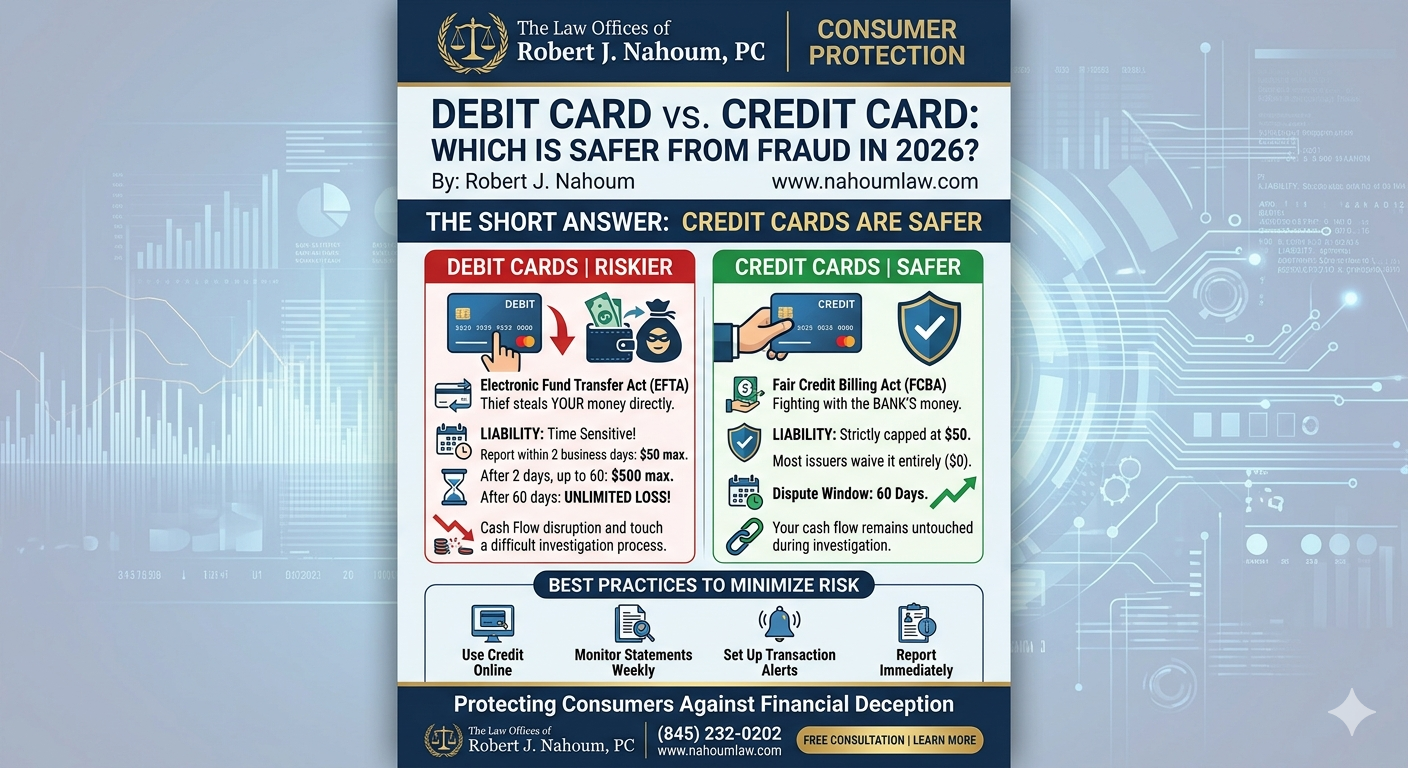
By: Robert J. Nahoum
Imposter scams trick victims into sending money or sharing bank details by posing as trusted entities like government agencies or banks. These frauds often result in unauthorized electronic fund transfers (EFTs), triggering protections under the Electronic Funds Transfer Act (EFTA). At The Law Offices of Robert J. Nahoum, P.C., we help consumers fight back against these violations.
What Are Imposter Scams?
Imposter scams involve fraudsters pretending to be authorities such as the IRS, Social Security Administration, or your bank to create urgency. Scammers frequently impersonate banks, government agencies (e.g., IRS or Social Security), businesses (e.g., Amazon), or family members to gain access or prompt action. Examples include:
- Bank imposters claiming account issues, urging wire transfers, gift cards, or P2P payments via Zelle/Venmo.
- Government scams demanding payment for fake debts or taxes.
- Romance or grandparent scams building rapport before requesting funds electronically.
In 2025, the FTC received over 1 million reports of imposter scams, with consumers losing more than $3.5 billion, the most reported fraud type. For government imposter scams alone, 332,796 reports from January to September 2025 caused $739 million in losses.
Older adults face heightened risk; reports of $10,000+ losses quadrupled since 2020, reaching $445 million for $100,000+ cases by 2024.
How Imposter Scams Cause Unauthorized EFTs
Scammers induce victims to share login credentials, account numbers, or routing info, then initiate EFTs like ACH debits or debit card pulls. Even if you “voluntarily” provide info under false pretenses, it’s unauthorized if done without actual authority and no benefit to you.
Examples include fake bank reps calling for “account verification” or tech support scams accessing your computer to drain funds. These qualify as unauthorized under Regulation E, part of EFTA.
EFTA and Regulation E Protections
The EFTA, via Regulation E (12 CFR Part 1005), limits consumer liability for unauthorized EFTs to $50 if reported within 2 business days of discovery, $500 if later but before 60 days, or unlimited after. Banks must investigate within 10 business days and provisionally credit funds during review.
Fraud-induced transfers count as unauthorized, even with shared credentials, negligence doesn’t increase liability. Report to your bank immediately, then file with FTC at ReportFraud.ftc.gov.
Statistics on the Rise
Total U.S. fraud losses hit $15.9 billion in 2025, up from $12.5 billion in 2024, with imposter scams leading reports. Business and government impersonations caused $2.95 billion in 2024 losses.
Steps to Protect Yourself and Recover
- Verify caller ID independently; never share info over unsolicited calls.
- Monitor statements daily via bank apps.
- If scammed, notify your bank within 2 days, place fraud alerts with Equifax, Experian, TransUnion.
Protecting Consumers Against Financial Deception
If you need help recovering money lost to an impersonation scam, contact us today to see what we can do for you. With offices located in Brooklyn and the Hudson Valey, the Law Offices of Robert J. Nahoum represents consumers in cases throughout the Tristate area including New Jersey.
The Law Offices of Robert J. Nahoum, P.C
(845) 232-0202
www.nahoumlaw.com
info@nahoumlaw.com
Disclaimer: This blog post is for informational purposes only and does not constitute legal advice. Laws and regulations are subject to change. Please consult with an attorney for advice regarding your specific situation.