
By: Robert J. Nahoum
Who is Marshal Martin Bienstock?
Martin A. Bienstock is a New York City Marshal (Badge No. 75) who works with debt collection law firms across New York City to execute judgments by garnishing wages and restraining bank accounts. NYC marshals are public officers appointed by the Mayor, but they are not salaried city employees and instead earn income by enforcing civil money judgments.
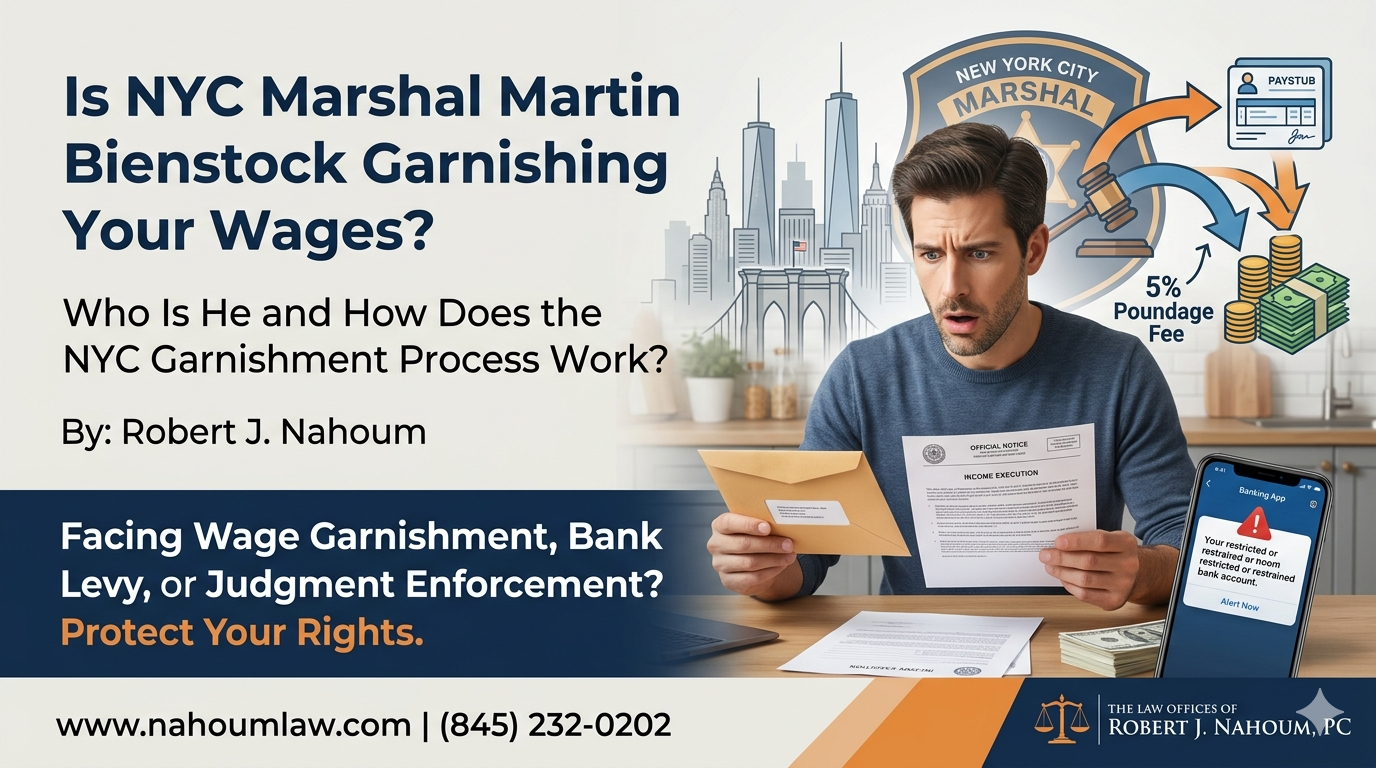
Marshal Bienstock’s office regularly assists judgment creditors to collect judgments throughout New York City. Like other NYC marshals, Bienstock can adds a 5% “poundage” fee to the judgment amounts he collects, which is taken from what is recovered from the consumer.
The role of New York City marshals in debt collection
New York City marshals are civil law enforcement officers who enforce money judgments from the NYC Civil Court, as well as Supreme and Family Courts, by seizing personal property, levying bank accounts, and garnishing wages. They do not get involved in the lawsuit itself; instead, once a creditor has a judgment, the marshal uses legal tools called “executions” to collect on that judgment.
Key points about NYC marshals in debt collection:
- They are appointed by the Mayor, but are not salaried city employees.
- They enforce private creditors’ judgments, including consumer debt, credit card, medical, and debt‑buyer judgments.
- They charge fixed statutory fees and keep 5% poundage from the money they collect.
- They can levy on personal property (like bank accounts, vehicles, and other non‑exempt assets) but cannot seize or sell real estate.
If you have been sued and a default judgment was entered against you years ago, a marshal like Bienstock can suddenly appear in the picture once a creditor decides to actively enforce that judgment. This is often when consumers first discover there was even a lawsuit.
How Marshal Bienstock garnishees wages
A wage garnishment in New York generally starts only after a creditor has already obtained a judgment against you. Once that judgment is in place, the creditor’s attorney can send an “Income Execution” to a New York City marshal such as Martin Bienstock, authorizing him to collect a percentage of your wages.
Under the NYC Department of Investigation’s marshal rules, the income execution and wage garnishment process works in two stages:
- Stage 1 – Income execution to the consumer
- Marshal Bienstock first mails or serves a copy of the income execution directly on you, the judgment debtor.
- This notice usually instructs you to pay a set percentage (often 10%) of your wages or other income voluntarily to his office.
- You are given a short time window (commonly 20 days) to start making payments before your employer is notified.
- Stage 2 – Income execution to the employer (wage garnishment)
- If you do not comply with the income execution, Marshal Bienstock can then serve the income execution on your employer.
- Once properly served, your employer is legally required to deduct a portion of your pay each period (not to exceed 10% of gross wages for most consumer judgments) and send it directly to the marshal.
- The marshal takes his statutory poundage and fees from the stream of payments and forwards the balance to the creditor.
The Marshal must also send you an exemption claim form, because certain income, such as Social Security, disability benefits, unemployment, and public assistance, is protected from garnishment. If your only income is exempt, you may be able to stop the garnishment by promptly asserting your exemptions in the proper way.
Other ways marshals like Bienstock enforce judgments
Wage garnishment is only one tool a marshal can use. NYC marshals, including Martin and Gregg Bienstock, can also:
- Levy and restrain bank accounts by serving a property execution on a bank where you hold funds.
- Seize and sell personal property (for example, vehicles or business assets) to satisfy judgments, subject to statutory exemptions.
- Negotiate payment arrangements in lieu of seizing and selling property, if the creditor agrees.
To do any of this, the marshal must have the necessary “execution” paperwork from the court and usually needs information about your employer or assets, which often comes from the creditor or from prior subpoenas. Marshals cannot seize exempt funds and must follow New York and federal protections for certain income and basic household property.
Consumers frequently first encounter Marshal Bienstock or other marshals after their bank accounts are suddenly frozen or their paychecks are unexpectedly reduced, which usually means a judgment is already in place and active enforcement has begun.
How The Law Offices of Robert J. Nahoum, PC can help
If you have received a Notice of Garnishment, income execution, or bank levy from Marshal Martin Bienstock, that does not mean you are out of options. The Law Offices of Robert J. Nahoum, PC, regularly represents New York consumers in debt collection lawsuits and post‑judgment enforcement, including challenging wage garnishments and bank levies where appropriate.
Depending on the case, potential strategies may include, for example: moving to vacate a default judgment, asserting exemptions, negotiating a reduced settlement, or setting up a manageable payment plan to avoid harsher enforcement.
The Law Offices of Robert J. Nahoum, P.C. represents New York consumers who are sued by debt collectors and who are facing judgment enforcement, including wage garnishments and bank restraints. You can learn more about our consumer protection and judgment enforcement practice and request a free consultation at https://www.nahoumlaw.com or contact us at (845) 232‑0202 to discuss your options.
Disclaimer: This blog post is for informational purposes only and does not constitute legal advice. Every case is different; you should speak with an attorney about your specific situation before making legal decisions.