By: Robert J. Nahoum
Hidden car dealer fees are at the center of a new Federal Trade Commission (FTC) case involving Stream Auto Outlet, a Long Island dealership group. The FTC alleges that the group advertised attractive prices online but later required consumers to pay thousands of dollars more. A proposed settlement would require more transparent advertising, but it does not require a fine or refunds to affected buyers.
For New York consumers, the case raises two important questions: What should an advertised car price actually include? And what can you do if the deal you signed looks nothing like the bargain that brought you into the showroom?
What did the FTC allege against Stream Auto Outlet?
On November 9, 2026, the FTC announced an agreement resolving deceptive-pricing allegations against Stream Auto Outlet, which operates dealerships in Amityville, Valley Stream, and Islip. The agency alleged that the dealerships advertised vehicles at artificially low prices and then refused to honor those prices without additional payments and charges.
As reported by Car Dealership Guy, the alleged practices included:
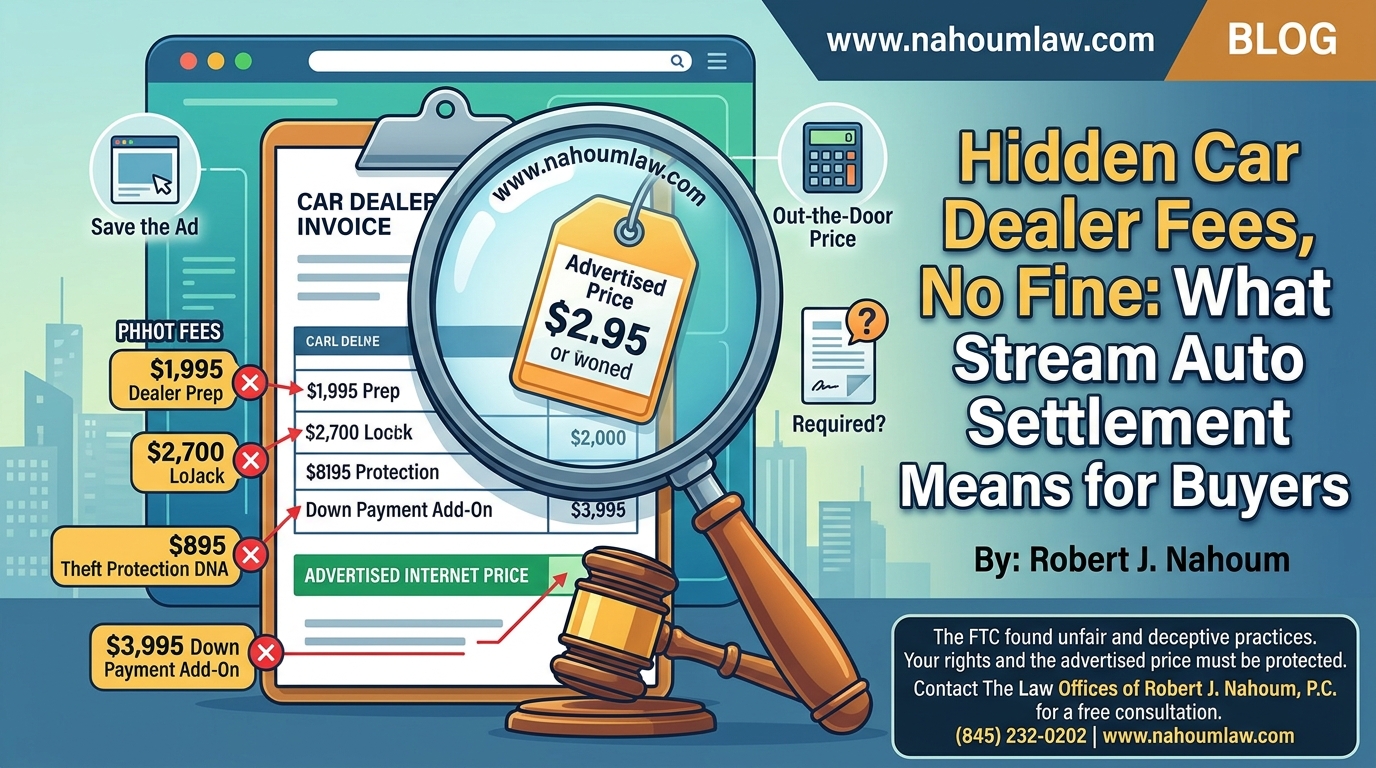
- An additional $3,995 down payment that was not included in the advertised “INTERNET SPECIAL” price.
- A $1,995 “dealer prep” fee.
- A $2,700 LoJack product that a consumer was told was required.
- An $895 “Theft Protection DNA” product.
The FTC also alleged that information about the additional down payment was buried in small-print language on a details page behind a pop-up. In other words, shoppers allegedly had to go looking for information that materially changed the advertised deal.
The FTC had already warned Stream Auto about its pricing practices in March 2026. According to the complaint, the group later promoted “NO FEES. NO GAMES. JUST CARS” while continuing to impose dealer fees and unwanted add-on charges.
Why the “extra down payment” matters
A down payment is not inherently improper. The concern here is how the dealer represented the vehicle’s price.
Consider a hypothetical example: A dealer advertises a car for $20,000. A shopper would ordinarily understand a $4,000 down payment to reduce the remaining purchase balance to $16,000, before other applicable charges and financing costs.
That is very different from learning that the advertised $20,000 price applies only after paying another $4,000, making the actual vehicle price $24,000.
The FTC’s complaint alleges that required down payments were added on top of advertised prices rather than included in them.
An advertised bargain does not tell shoppers much if they cannot use it to compare the actual cost of one vehicle with another.
What must an advertised car price include?
The FTC’s September 2026 pricing guidance states that an advertised vehicle price must reflect the price any consumer can walk in and pay, including mandatory fees. Charges that the government requires consumers to pay may be excluded.
The proposed Stream Auto order follows that approach. It defines “Total Price” to include all mandatory fees and charges, except government-required charges, and would require that total to be clearly disclosed as the most prominent price in visual advertising.
The practical distinction is between a government-required charge and an amount the dealership itself requires you to pay. Giving a dealer-imposed charge an official-sounding name does not turn it into a government charge.
For more background, read our explanation of what the FTC’s auto dealer pricing transparency guidance means for consumers.
Does fine print fix a misleading advertised price?
Not necessarily. In this case, the FTC specifically challenged disclosures hidden behind a pop-up and mixed with other small-print information. The proposed order would require disclosures that are easily noticeable and understandable; online disclosures must be unavoidable.
The important consumer takeaway is that the headline price matters. A dealership should not use a prominent low price to attract shoppers while making the real price difficult to discover.
What does the Stream Auto settlement require?
Under the proposed order, Stream Auto would be prohibited from misrepresenting important aspects of a vehicle transaction, including:
- The costs or terms of buying, financing, or leasing a vehicle.
- Whether a vehicle is available at an advertised price.
- Whether fees, products, or services are optional or required.
- Whether a particular financing source is required.
- Whether a consumer authorized a charge or product.
The order also includes recordkeeping and monitoring requirements. For five years after entry of the order, the Stream must create specified records, including advertisements, negotiation worksheets, transaction documents, and consumer complaints, and retain each record for five years. A sworn compliance report is due one year after entry. The FTC could also check compliance by having representatives pose as consumers.
No fine—and no automatic refund for buyers
The absence of monetary relief is one of the most significant parts of this story.
The settlement carries no monetary fine nor does it provide compensation to customers who previously purchased cars from Stream Auto.
That creates a gap between changing a dealership’s practices and helping someone who already paid an allegedly inflated price.
A consumer who believes they were harmed should not mistake this announcement for a refund notice. An individual transaction requires its own review; the FTC’s allegations do not, by themselves, establish what happened in every buyer’s deal.
What should you do about hidden car dealer fees?
The allegations in this case offer a useful checklist for reviewing a purchase before—or after—you sign.
- Save the advertisement
Keep screenshots showing the vehicle, advertised price, vehicle identification number, date, and any disclaimers. Save the details page too, not just the main listing.
The difference between the advertised price and the transaction documents is central to the FTC’s case. Preserving both gives an attorney a clearer record to evaluate.
- Request an itemized, out-the-door price
Before traveling to the dealership, ask for a written breakdown showing:
- The vehicle’s selling price.
- Every dealer-imposed fee.
- Any add-on products.
- Taxes, title, and registration charges.
- The total amount due before financing costs.
This helps identify the kind of mandatory charges the FTC says must be included in advertised vehicle prices.
- Ask what “required” actually means
If a salesperson says a warranty, tracking device, theft-protection product, or financing arrangement is required, ask who requires it and request the explanation in writing.
That question matters because the proposed Stream Auto order specifically addresses misrepresentations about required products, fees, and financing sources.
- Compare the paperwork—not just the monthly payment
Compare the advertisement, buyer’s order, and financing agreement. Look for changes in the selling price, unfamiliar products, and charges that were not discussed.
Our guide, “Is Your Car Dealer Ripping You Off?”, discusses reviewing a retail installment sales contract. You can also read about receiving a copy of your vehicle sales and financing contract.
- Preserve your complaint and the dealer’s response
Keep emails, texts, receipts, product agreements, and written requests to remove or explain charges. Write down who said a product was mandatory and when that conversation occurred.
The proposed order’s requirement to preserve consumer complaints, refund requests, and transaction communications underscores how important those records can be when evaluating a pricing dispute.
Questions New York car buyers may have
Is every car dealer fee illegal?
No. The issues in this case concern misleading pricing, excluded mandatory charges, and representations about whether products or fees were required. A charge’s existence alone does not answer whether the dealership properly advertised, explained, and obtained authorization for it.
Will the FTC send me a refund?
The proposed Stream Auto settlement does not establish a consumer refund program. Buyers should not assume that an FTC enforcement announcement means reimbursement is coming.
Speak with a New York consumer protection lawyer
A low advertised price should help you shop, not conceal the amount you will actually have to pay.
If your paperwork shows unexplained fees, products you did not knowingly agree to purchase, or a price substantially higher than the advertisement, a review of the advertisement, communications, and signed documents can help identify the issues.
The Law Offices of Robert J. Nahoum, P.C. represents consumers in auto fraud and deceptive dealership disputes. To discuss your situation, contact our office or call (845) 232-0202.
At The Law Offices of Robert J. Nahoum, P.C., we represent consumers dealing with unfair, deceptive, and unlawful practices involving credit reporting, debt collection, auto finance, and consumer transactions. If an auto loan, credit-report item, or collection demand is the result of identity theft or inaccurate information, legal help may be available.
Contact our office today for a free case evaluation.
- Phone: (845) 232-0202
- Email: info@nahoumlaw.com
- Online: www.nahoumlaw.com/contact
For a free consultation about an auto‑fraud or deceptive‑sales issue, contact us at our Hudson Valley office or our Brooklyn location.
📞 Call (845) 232‑0202 or visit our contact page: www.nahoumlaw.com/contact
This article is provided for general informational purposes only and is not legal advice. Every matter depends on its particular facts and applicable law.