
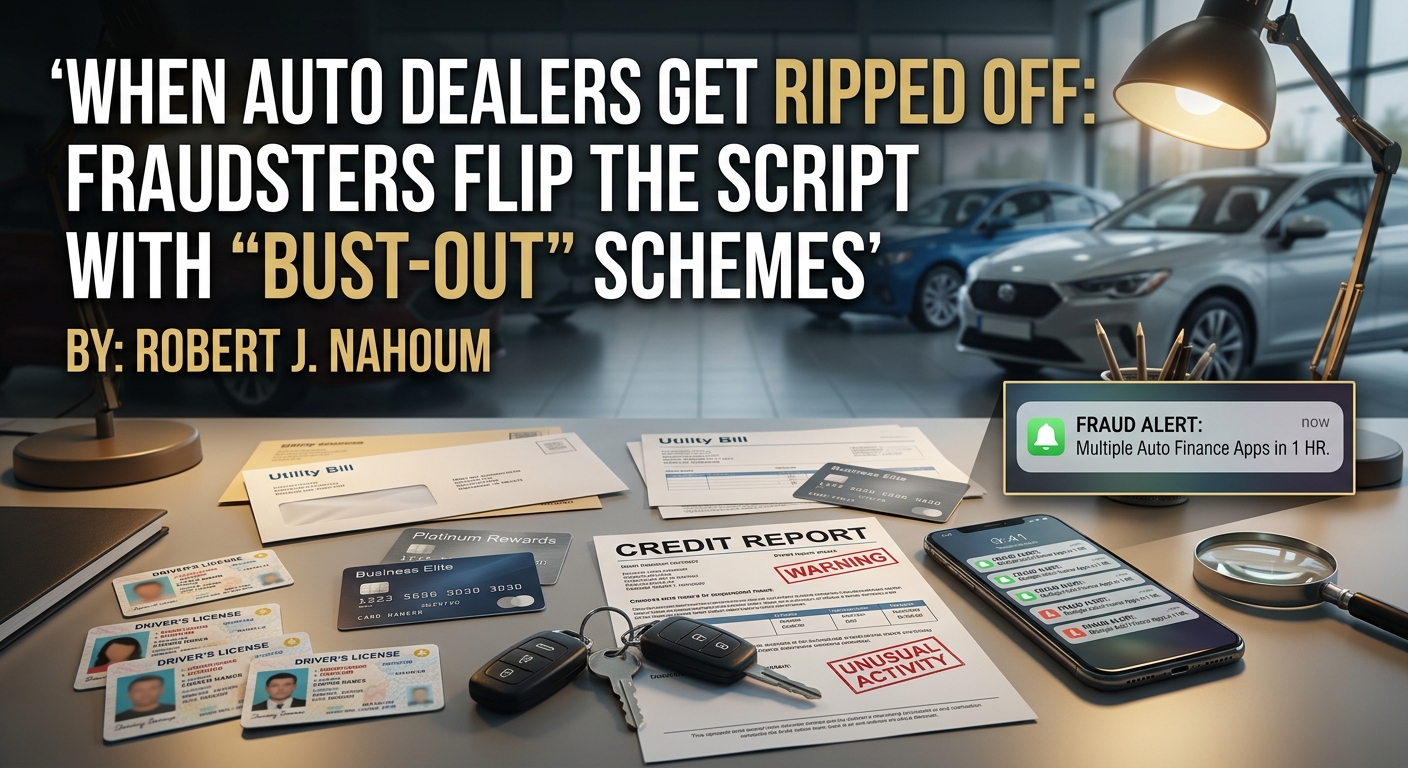
By: Robert J. Nahoum
For decades, many car buyers have walked into dealerships at a disadvantage. Dealers and their finance departments often have superior information, sophisticated sales systems, and a powerful incentive to close a deal—even when the financing, add-ons, or representations are not in the consumer’s best interest.
But a recent report highlights an unusual reversal: organized fraud rings are increasingly targeting auto dealers and finance companies through so-called “bust-out” fraud schemes.
The story is not an excuse for dealers to mistreat legitimate customers. It is, however, a reminder that the auto-sales and auto-finance system has vulnerabilities on every side—and that the industry’s rush to approve, fund, and sell vehicles can create real opportunities for abuse. Automotive News reports that fraudsters are moving rapidly from dealership to dealership, obtaining expensive vehicles through illegitimate loans before standard credit-reporting systems can catch up. autonews
What Is Auto-Finance “Bust-Out” Fraud?
A “bust-out” is a deliberate fraud scheme designed to make an applicant look financially trustworthy—right up until the moment the fraudster takes on as much credit as possible and vanishes.
In the auto context, the alleged playbook is straightforward:
- A fraudster uses a stolen, manipulated, or synthetic identity, or sometimes a real person whose identity is being exploited.
- The fraudster builds or maintains a credit profile that appears legitimate: an acceptable score, paid accounts, and a history that does not immediately trigger suspicion.
- Once the profile looks strong enough, the fraudster applies for auto financing at multiple dealerships in a compressed period.
- The group obtains high-value vehicles and moves them quickly—through resale, shipment, retitling, dismantling, or another channel designed to make recovery difficult.
- The loans go unpaid, while the lender and, in some cases, the dealership are left trying to recover vehicles that may already be gone.
The key is timing. As Automotive News describes it, scammers target multiple dealerships in an area in a short window. A dealer reviewing the application may not yet see the other newly opened auto loans because conventional credit reporting and lender systems do not update in real time. autonews
The Script Has Been Flipped
The phrase “buyer beware” has long been associated with car buying. Consumers have good reason to be cautious about misleading advertising, undisclosed vehicle defects, inflated prices, bait-and-switch tactics, hidden fees, payment packing, inaccurate trade-in valuations, and expensive finance-and-insurance products.
Bust-out fraud flips the familiar dynamic. This time, the dealership is the party being manipulated.
That does not mean dealers are powerless. Auto retailers have access to document-verification tools, credit information, lender relationships, customer databases, sales records, and trained finance personnel. Yet fraud rings exploit a weakness that even sophisticated systems struggle to solve: information arrives late.
A dealership may verify an identity and see a respectable credit profile. What it may not know is that the same identity—or a coordinated group using similar tactics—has already obtained or is simultaneously seeking several other financed vehicles across town.
Why These Schemes Are So Effective
Bust-out fraud does not always look like the crude, obvious fraud people imagine. A forged driver’s license, an altered pay stub, or a plainly fake address may be caught by a careful review. The harder cases are designed to look normal.
The alleged fraudster may present:
- A credit profile with apparently good payment history.
- Plausible employment and income documentation.
- An identity that matches enough available data to pass superficial review.
- A customer who seems eager, prepared, and able to qualify.
- A transaction that appears routine when viewed in isolation.
Meanwhile, the alleged fraud ring may be counting on dealers, lenders, and credit-reporting systems to operate separately rather than as a real-time coordinated network.
That is particularly significant with expensive, mobile collateral. Unlike many consumer purchases, a financed vehicle can be driven away the same day, moved across state lines, loaded into a shipping container, altered, resold, stripped for parts, or otherwise made difficult to recover.
A Lesson the Auto Industry Should Not Ignore
The auto industry often emphasizes speed: fast online credit decisions, express delivery, quick funding, and “drive home today” marketing. Those conveniences can benefit honest consumers. But speed can also become a fraud vulnerability when it replaces verification.
The practical lesson for dealers and lenders is not to presume that every customer with a good credit score is legitimate. Rather, they should focus on suspicious combinations of circumstances, including:
- Applications for high-value or easily resold vehicles.
- Unusual urgency to complete delivery.
- Identity, address, employment, insurance, or income details that cannot be independently verified.
- Recently established or unusually thin credit histories that nevertheless show a strong score.
- Inconsistencies between the application, credit report, identification documents, insurance records, and customer behavior.
- Signs that multiple applicants are using the same contact information, address, employer, bank account, device, document template, or other common data points.
- A pattern of multiple major credit applications in a very short period.
The point is not to turn legitimate customers into suspects. It is to use reasonable procedures, apply them consistently, and investigate genuine red flags before releasing a high-value vehicle.
Consumers Still Need Protection
There is a broader consumer-protection lesson here as well.
Fraud in auto finance can harm more than dealerships and lenders. Identity theft victims may discover loans, repossession activity, collection efforts, or damaged credit connected to vehicles they never bought. A consumer whose identity has been stolen can spend months or years disputing inaccurate accounts, repairing credit reports, communicating with lenders, and trying to stop collection activity.
Consumers who find an unfamiliar auto loan or vehicle-related account on a credit report should act quickly:
- Obtain copies of credit reports from all three nationwide credit reporting agencies.
- Dispute inaccurate information in writing and retain proof of submission.
- Contact the lender’s fraud department and request the underlying application and account documents.
- Consider placing a fraud alert or security freeze on credit files.
- File an identity-theft report through the Federal Trade Commission and, where appropriate, a police report.
- Preserve every letter, email, credit-report entry, account statement, and communication tied to the suspected fraud.
- Speak with a consumer-protection attorney if the lender, collector, dealership, or credit reporting agency fails to correct false information.
A person should not have to pay for, defend, or repair the consequences of an auto loan obtained by someone else.
At The Law Offices of Robert J. Nahoum, P.C., we represent consumers dealing with unfair, deceptive, and unlawful practices involving credit reporting, debt collection, auto finance, and consumer transactions. If an auto loan, credit-report item, or collection demand is the result of identity theft or inaccurate information, legal help may be available.
Contact our office today for a free case evaluation.
- Phone: (845) 232-0202
- Email: info@nahoumlaw.com
- Online: www.nahoumlaw.com/contact
For a free consultation about an auto‑fraud or deceptive‑sales issue, contact us at our Hudson Valley office or our Brooklyn location.
📞 Call (845) 232‑0202 or visit our contact page: www.nahoumlaw.com/contact
This article is provided for general informational purposes only and is not legal advice. Every matter depends on its particular facts and applicable law.