
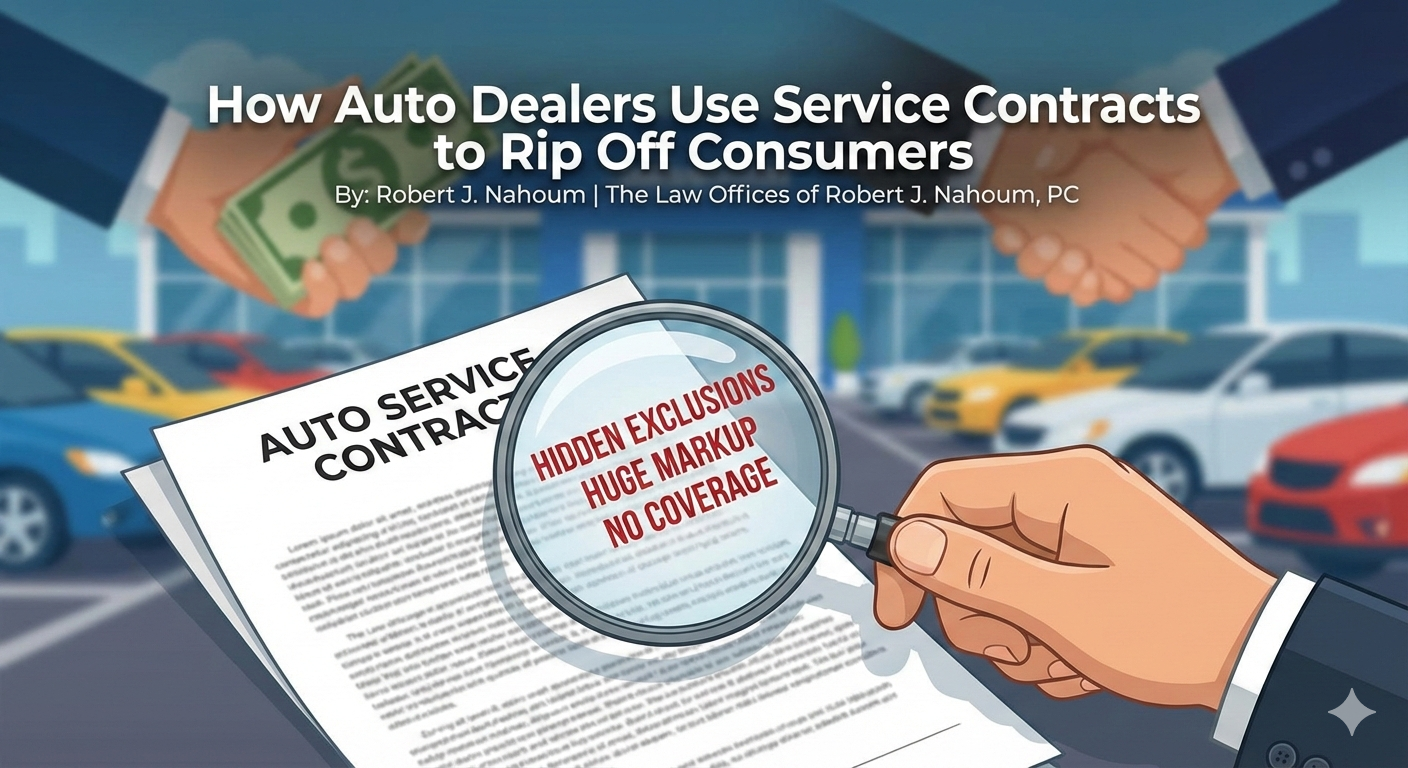
By: Robert J. Nahoum
What is a service contract?
A service contract is a written agreement to perform maintenance or repair services on a consumer product—like a car—over a fixed period of time or for a specified duration. In the auto‑dealership world, these are often marketed as “extended warranties” or “vehicle protection plans,” but legally they are separate contracts that you pay extra for, beyond the manufacturer’s warranty.
Unlike a factory warranty that comes included in the price of the vehicle, a service contract is an add‑on that can cover repairs for certain parts (engine, transmission, electronics, etc.) if they fail after the original warranty expires. On paper, that sounds helpful; in practice, many dealers use these contracts to pad their profits and shift risk onto the consumer.
How auto dealers use service contracts to rip off consumers
Auto dealers profit heavily from service contracts, and that profit motive creates strong incentives to mislead, overcharge, or under‑deliver. Here are the most common ways dealers exploit these contracts:
- Huge markups with little added value
Dealers often buy service contracts from third‑party administrators at a fraction of what they charge the customer. A contract that costs the dealer a few hundred dollars may be sold to you for thousands, with most of the extra going straight to the dealership’s bottom line. In many cases, the coverage you receive is far less valuable than the price you pay, making the “protection” a poor financial bet.
- Misrepresenting coverage or pretending coverage exists
Some dealers sell service contracts that either provide no meaningful coverage or exclude the very vehicle you bought (for example, certain makes, models, or modified vehicles). Others fail to send the paperwork or payment to the third‑party administrator altogether, so no real contract ever takes effect—you’ve paid for coverage that doesn’t exist. This is not just misleading; it can amount to fraud or deceptive trade practices under state and federal law.
- Hidden exclusions and “fine print” traps
Service contracts are typically loaded with exclusions, limitations on covered systems, and lifetime caps on what the administrator will pay per repair or per system. A dealer may verbally promise “full coverage” while the contract itself excludes common failures, wear‑and‑tear items, or repairs done at independent shops. When a claim is denied because of these buried exclusions, consumers are left footing large repair bills they believed were covered.
- Steering customers away from cheaper or better options
Dealers often pressure buyers to purchase the service contract on the spot, during the stressful final stages of the deal, while downplaying cheaper alternatives such as manufacturer‑backed extended warranties or third‑party plans with better terms. This “bait‑and‑switch” dynamic—promising peace of mind while obscuring the true cost and limitations—can violate consumer‑protection laws that prohibit unfair or deceptive sales practices.
Service contracts vs. warranties: why the distinction matters
Many consumers think a service contract is just another kind of warranty, but there are important legal and practical differences:
- Warranties are usually included in the purchase price and come directly from the manufacturer or seller.
- Service contracts are optional add‑ons, often administered by a third party, and sold for extra money.
Because service contracts are separate contracts, dealers have more leeway to design them with narrow coverage, high deductibles, and aggressive exclusions. That’s why it’s critical to read the contract carefully and not rely on sales talk. If a dealer misrepresents a service contract as a warranty, or implies broader coverage than the document provides, you may have grounds for a claim under consumer‑protection statutes or warranty‑disclosure laws.
When you may have legal recourse
If an auto dealer sold you a service contract that:
- Does not actually exist (no paperwork sent to the administrator),
- Provides no meaningful coverage for your vehicle,
- Contains undisclosed exclusions that make the contract essentially worthless, or
- Was misrepresented as a warranty or “full coverage,”
you may have remedies under:
- State consumer‑fraud or deceptive‑trade‑practices statutes (such as New York’s General Business Law § 349),
- Federal and state warranty‑disclosure and truth‑in‑advertising rules, and
- Contract and fraud principles if the dealer never intended to provide the coverage it sold.
At The Law Offices of Robert J. Nahoum, P.C., we help consumers fight back against deceptive auto‑dealer practices, including abusive service‑contract sales. If you believe you were misled into buying an overpriced or worthless service contract, you may be entitled to rescission, refund, or damages under applicable consumer‑protection laws.
How to protect yourself when buying a service contract
Before signing anything at the dealership, consider these steps:
- Ask for the full contract text in writing and read it before agreeing.
- Compare it to the manufacturer’s warranty to see what is already covered and what the service contract actually adds.
- Call the third‑party administrator listed in the contract to confirm your coverage is active and understand the limits.
- Shop around for independent extended‑warranty or service‑contract options, and negotiate the price—many dealers are willing to reduce the markup.
If you feel pressured, confused, or misled during the service‑contract sale, it is usually safer to walk away and revisit the decision later, once you’ve had time to review the terms.
Need help with an abusive auto‑dealer service contract?
If you suspect an auto dealer used a service contract to overcharge you, mislead you, or sell you coverage that doesn’t exist, you may have legal rights under consumer‑protection and warranty‑disclosure laws. The Law Offices of Robert J. Nahoum, P.C. represents consumers in cases involving deceptive auto‑dealer practices, including abusive service‑contract sales and other forms of consumer‑finance misconduct.
Visit our Consumer Protection page to learn more about how we help consumers fight back against unfair business practices, or contact us directly to discuss your situation.
For a free consultation about an auto‑fraud or deceptive‑sales issue, contact us at our Hudson Valley office or our Brooklyn location.
📞 Call (845) 232‑0202 or visit our contact page: www.nahoumlaw.com/contact