
By: Robert J. Nahoum
If you discovered a default judgment against you for a debt you don’t recall being sued over, you may have been the victim of improper service of process. At The Law Offices of Robert J. Nahoum, P.C., we help consumers undo these judgments using a legal mechanism called an Order to Show Cause (OSC).
Below are answers to the most common questions we receive about vacating default judgments based on bad service.
What Is an Order to Show Cause to Vacate a Default Judgment?
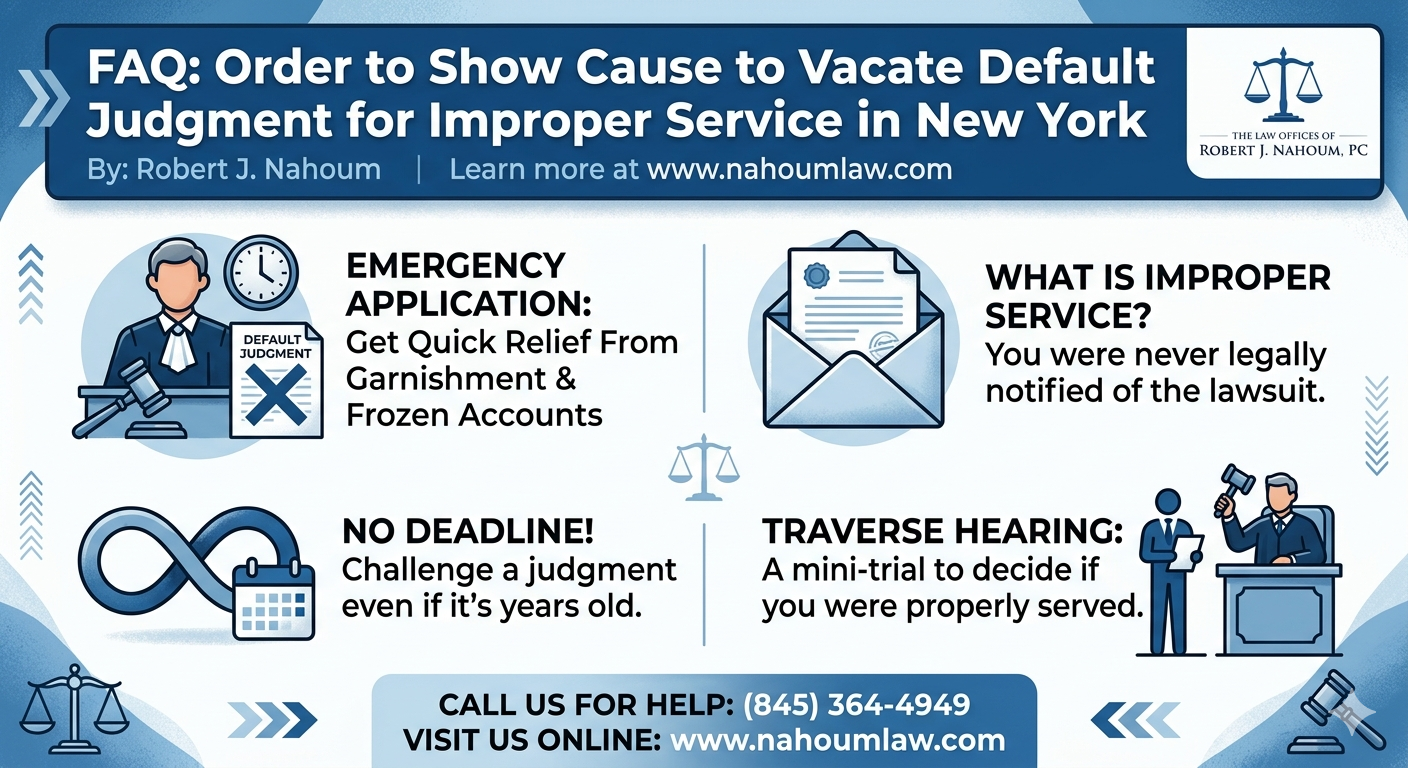
An Order to Show Cause (OSC) is an emergency application filed with the court asking a judge to immediately review and cancel (vacate) a default judgment entered against you.
Unlike a standard motion, which can take months to be decided, an OSC is used when urgent relief is needed, such as stopping a wage garnishment or frozen bank account. When based on improper service of process, the OSC asks the court to declare the judgment void because you were never legally notified of the lawsuit in the first place.
What Is “Improper Service of Process”?
“Service of process” is the legal delivery of the summons and complaint that notifies you of a lawsuit. Debt collectors must follow strict rules when serving you. Common methods include:
- Personal Delivery: Handing the papers directly to you.
- Substituted Service: Leaving papers with a person of “suitable age and discretion” at your home and mailing a copy to you.
- Nail and Mail – After at least three failed attempts at personal or suitable age and discretion service, the process server may post a copy of the summons and complaint to your door and mail a copy to your last known address.
Service is improper (and legally void) if the process server:
- Left papers with a neighbor or child who wasn’t of suitable age.
- Delivered papers to an old address where you no longer live.
- Falsified an Affidavit of Service claiming they handed you papers when they did not.
- Served you at a location where you clearly do not reside or work.
If service was improper, the court never acquired personal jurisdiction over you, meaning any judgment entered is legally invalid.
Is There a Deadline to File an Order to Show Cause for Improper Service?
No. This is the most critical advantage of challenging a judgment based on improper service.
- Excusable Neglect: If you were served properly but simply forgot to answer, you generally have one year from the judgment date to move to vacate.
- Improper Service (Lack of Jurisdiction): If you were never properly served, there is no time limit. You can file an Order to Show Cause to vacate the judgment even if it was entered five or ten years ago.
Will Filing an OSC Stop Wage Garnishment Immediately?
Filing the OSC does not automatically stop garnishment, but your attorney can request a Stay of Enforcement within the application.
If the judge grants the OSC and the Stay, your employer or bank must immediately halt any garnishment or levy while the court reviews your case. This provides immediate financial relief while the legal challenge proceeds.
What Is a Traverse Hearing?
If the judge grants your Order to Show Cause, they may schedule a Traverse Hearing. This is a specialized mini-trial where the only issue is: Was service of process proper?
- You Testify: You will swear under oath that you never received the summons and complaint or that the method used was illegal.
- Process Server Testifies: The individual who claims to have served you must appear and defend their affidavit.
- The Decision: If you prove service was improper, the judge will vacate the default judgment entirely. The debt collector is then back to square one and must re-serve you properly if they wish to pursue the debt.
Why Do Debt Collectors Rely on Improper Service?
Unfortunately, “sewer service” (fake service) remains a problem in debt collection. Some unscrupulous process servers submit templated or falsified Affidavits of Service claiming they handed you papers when they never even visited your address.
This tactic relies on consumers never checking their court records. By the time the consumer discovers the judgment (often when their paycheck is garnished), the default has already been entered, and the debt collector has a court order to collect. Learn more about these tactics in our guide on What to Do If You Are Sued by a Debt Collector.
Can I Sue the Debt Collector for Improper Service?
Yes. If a debt collector sued you and obtained a judgment based on false affidavits of service, they may have violated the Fair Debt Collection Practices Act (FDCPA).
Vacating the underlying judgment is often the necessary first step before you can file a counterclaim or separate lawsuit for statutory damages, actual damages, and attorney’s fees. For more on your rights, see our page on the Fair Debt Collection Practices Act.
What Happens After the Judgment Is Vacated?
Once the judge signs the order vacating the judgment:
- The Judgment Is Erased: It is removed from your public record and should be deleted from your credit report.
- Garnishments Stop: Any active wage or bank garnishments must cease immediately.
- The Case Is Reopened: The debt collector has the option to properly serve you and restart the lawsuit. However, many debt collectors choose not to pursue the case once their fraudulent service is exposed.
Do I Need a Lawyer to File an Order to Show Cause?
While you can file pro se (on your own), it is highly inadvisable. Debt collection firms aggressively defend against OSC applications. They will argue that service was proper and that you are simply trying to delay paying a valid debt.
An experienced consumer protection attorney knows how to:
- Subpoena the process server’s daily logs and GPS data to prove they weren’t at your address.
- Cross-examine the process server effectively at the Traverse Hearing.
- Preserve your right to sue for FDCPA violations.
Contact Us for Help
If you have a default judgment against you that you knew nothing about, do not assume it is too late. The Law Offices of Robert J. Nahoum, P.C. represents consumers through the tristate area.
We can evaluate your case, obtain the affidavit of service, and file the necessary Order to Show Cause to vacate the judgment and stop collection efforts.
Contact us today for a consultation. Call (845) 364-4949 or visit our Consumer Protection practice area to learn more.
Disclaimer: This FAQ is for informational purposes only and does not constitute legal advice. Laws change, and every case is unique—consult a qualified New York attorney at Nahoum Law for guidance on your specific situation.