
By: Robert J. Nahoum
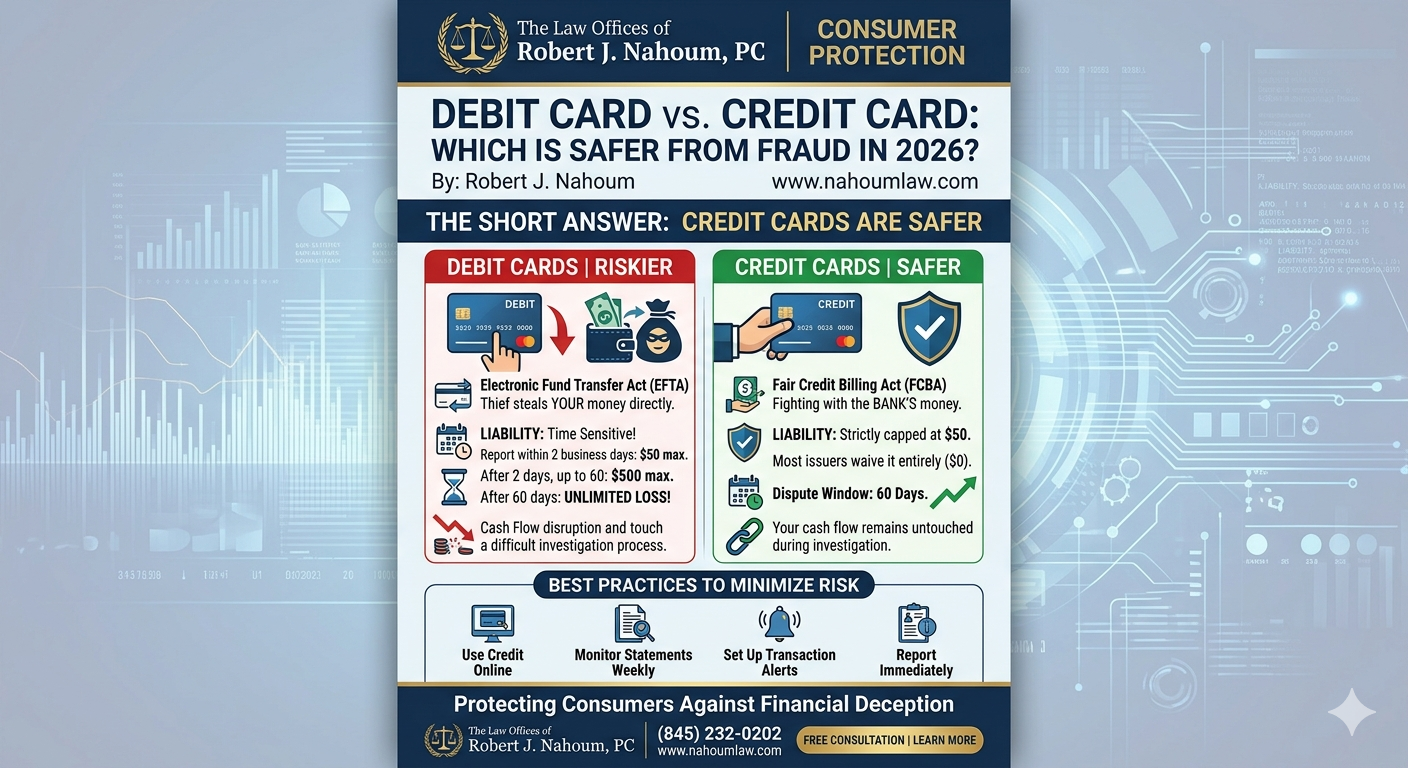
The Short Answer: Credit Cards Are Safer
If your wallet is stolen or your card details are compromised, a credit card is significantly safer than a debit card due to federal liability limits and the source of funds during a dispute.
When fraud occurs on a credit card, you are fighting with the bank’s money. Your liability is capped at $50, and most major issuers waive even that amount. On the other hand, when fraud occurs on a debit card, the thief has stolen your money directly from your checking account. While your liability can also be capped at $50, strict reporting deadlines apply; miss them, and you could lose unlimited amounts of your own cash while the bank investigates.
At The Law Offices of Robert J. Nahoum, PC, we frequently represent consumers who have suffered devastating losses due to unauthorized electronic fund transfers. Understanding the legal distinctions between these payment methods is the first step in protecting your assets.
The Legal Framework: Why the Laws Differ
The disparity in safety stems from two distinct federal statutes that govern how banks must handle errors and fraud.
- Credit Cards: The Fair Credit Billing Act (FCBA)
Credit cards are governed by the Fair Credit Billing Act (FCBA). This law treats unauthorized charges as a “billing error” rather than a theft of funds.
- Maximum Liability: Your liability is strictly limited to $50 per card, regardless of how much was stolen.
- Zero Liability Policies: In practice, Visa, Mastercard, and American Express almost universally waive this $50, meaning you pay $0 for fraudulent charges.
- Dispute Window: You have 60 days from the date the statement containing the error was mailed to you to dispute the charge in writing.
- Investigation Rights: During the investigation, you do not have to pay the disputed amount, and the creditor cannot report it as delinquent.
- Debit Cards: The Electronic Fund Transfer Act (EFTA)
Debit cards fall under the Electronic Fund Transfer Act (EFTA), implemented by Regulation E. This law protects electronic fund transfers (EFTs) but imposes a “ticking clock” on consumers that does not exist for credit cards.
Your liability depends entirely on how quickly you report the loss:
| When You Report the Loss | Your Maximum Liability |
| Before any unauthorized transfers occur | $0 |
| Within 2 business days of learning of loss/theft | $50 |
| After 2 business days but within 60 days of statement | $500 |
| After 60 days from statement transmittal | Unlimited (you could lose your entire account balance) |
The Critical Trap: If you fail to review your bank statement and report an unauthorized transfer within 60 days of the statement being sent, you lose all protection for any transfers that occur after that 60-day window. In cases of “slow drain” fraud, where thieves take small amounts over months, victims who miss this deadline often find their accounts completely emptied with no legal recourse to recover the funds.
Why Debit Cards Are Riskier for Consumers
Beyond the liability caps, the practical impact of fraud differs drastically between the two card types.
Cash Flow Disruption
When a debit card is compromised, the money is gone from your checking account immediately. This can cause your rent checks to bounce, and your automatic bill payments to fail among other catastrophes. While Regulation E requires banks to provisionally credit funds within 10 business days of notice, this is not immediate, and the bank can take up to 45 days to complete its investigation.
With a credit card, your cash flow remains untouched. You simply refuse to pay the disputed line item while the issuer investigates.
Burden of Proof
Under the FCBA (credit), the burden is often on the creditor to prove the charge was valid. Under Regulation E (debit), while the bank must investigate, the consumer often faces a more rigorous verification process to prove they did not authorize the transfer, especially if the bank suspects “friendly fraud”.
Best Practices for Protecting Your Accounts
To minimize your risk of unauthorized transfers, follow these guidelines:
- Use Credit for Online Purchases: Always use a credit card for e-commerce and recurring bills. The legal protections are superior, and your actual bank balance remains secure.
- Monitor Statements Weekly: Do not wait for the monthly statement. Check your debit card transactions via your banking app every few days to catch the “2-business-day” window.
- Set Up Alerts: Configure text or email alerts for any transaction over a specific dollar amount (e.g., $10).
- Report Immediately: If you see a charge you don’t recognize, call your bank immediately. Do not wait. For debit cards, speed is the only thing standing between a $50 loss and a total account drain.
- Freeze Your Credit: If you suspect identity theft, freeze your credit files with Equifax, Experian, and TransUnion to prevent new accounts from being opened in your name.
Have You Been a Victim of Unauthorized Transfers?
If your bank has refused to reimburse you for unauthorized electronic fund transfers, or if you have lost money due to a delayed report, you may have rights under the EFTA and Regulation E. Banks sometimes wrongfully deny claims, miss investigation deadlines, or incorrectly calculate liability limits.
At The Law Offices of Robert J. Nahoum, PC, we focus on holding financial institutions accountable. We represent consumers in disputes involving:
- Unauthorized debit card charges
- Hacked online banking accounts
- Failure to provisionally credit funds
- Violation of Regulation E investigation timelines
Contact us today for a free consultation to discuss your case. We also invite you to learn more about our Consumer Protection practice area.
Protecting Consumers Against Financial Deception
If you need help recovering money lost to an impersonation scam, contact us today to see what we can do for you. With offices located in Brooklyn and the Hudson Valey, the Law Offices of Robert J. Nahoum represents consumers in cases throughout the Tristate area including New Jersey.
The Law Offices of Robert J. Nahoum, P.C
(845) 232-0202
www.nahoumlaw.com
info@nahoumlaw.com
Disclaimer: This blog post is for informational purposes only and does not constitute legal advice. Laws and regulations are subject to change. Please consult with an attorney for advice regarding your specific situation.