
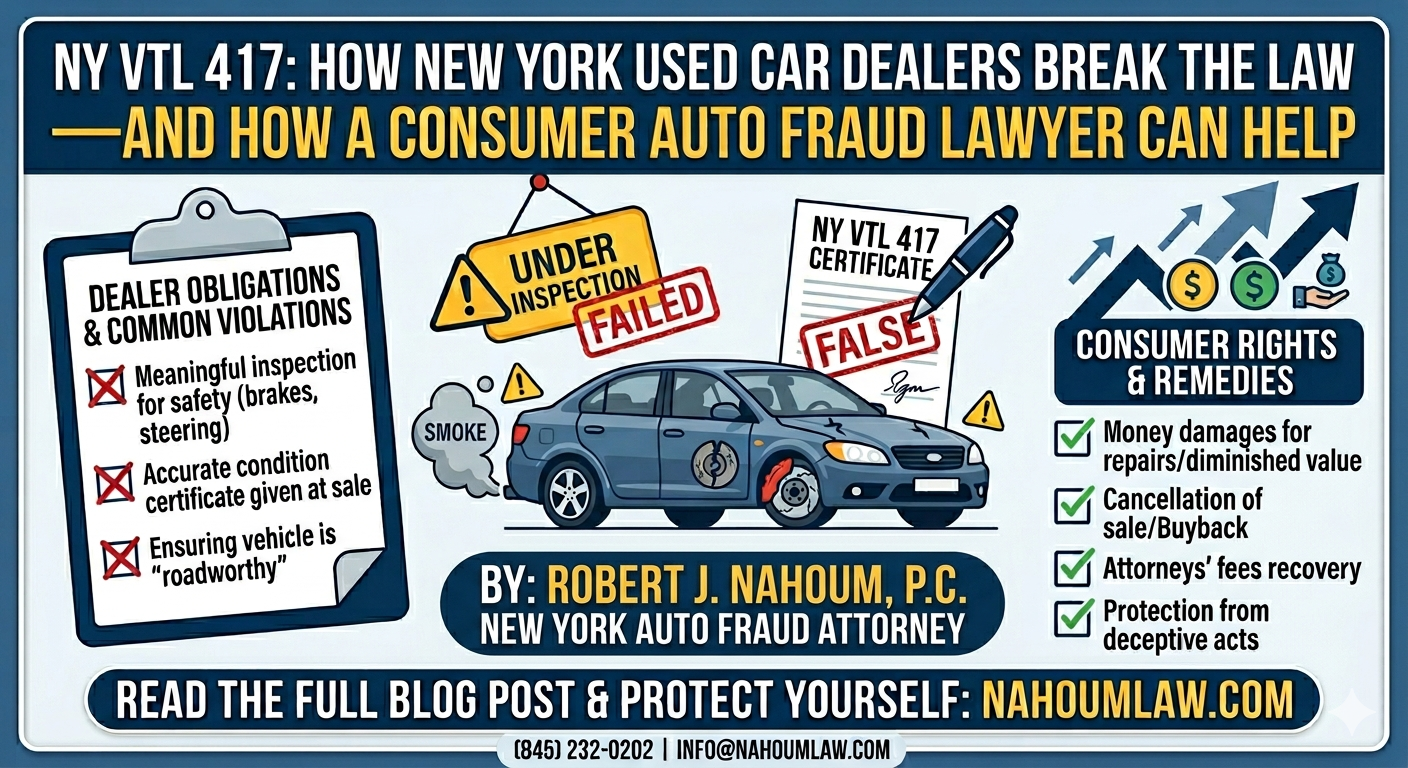
By: Robert J. Nahoum
What Is NY VTL 417?
New York Vehicle and Traffic Law § 417 requires retail dealers selling second‑hand motor vehicles to provide a written certificate about the condition and safety of the car at the time of sale. This certificate must follow a form prescribed by the Commissioner of Motor Vehicles and is meant to ensure the vehicle is in safe, roadworthy condition when it leaves the lot. The law also makes it a violation for a dealer to fail to deliver this certificate, or to deliver a false or misleading one, especially where no proper inspection was actually done.
In plain terms, NY VTL 417 is supposed to prevent dealers from selling unsafe, defective used lemons onto unsuspecting buyers while pretending they have been properly inspected. When a dealer violates this law, the consumer may have significant claims for damages and other remedies under New York law.
Dealer Obligations Under NY VTL 417
Under NY VTL 417, a retail dealer selling a second‑hand motor vehicle must:
- Perform an appropriate inspection of the vehicle before sale to determine its condition.
- Provide the buyer with a written certificate, in the form required by DMV, stating that the vehicle is in condition and repair reasonably safe and proper to be operated on public highways.
- Ensure that the information in the certificate is accurate and not misleading, based on that inspection.
The statute goes further and makes clear that:
- Failure to deliver the required certificate is a violation of the law.
- Delivering a false certificate, or one issued without an appropriate inspection, is also a violation.
- If the certificate is false, the law presumes that the dealer did not perform an appropriate inspection as required.
NY VTL 417 works together with other consumer protection laws, including New York’s “Used Car Lemon Law,” odometer statutes, mandatory disclosure statutes like VTL 417‑a and 417‑b, and general fraud and deceptive practice laws.
Common Ways Dealers Violate NY VTL 417
In my auto fraud practice at The Law Offices of Robert J. Nahoum, P.C., I see recurring patterns of how dealers skirt or outright ignore NY VTL 417. These violations often show up alongside other auto fraud tactics like yo‑yo sales, hidden finance charges, and undisclosed prior damage.
Typical NY VTL 417 violations include:
- No real inspection at all
The dealer hands over a boilerplate “inspection” or condition certificate, but the vehicle was never meaningfully inspected for safety issues such as brakes, steering, suspension, or structural damage. The presumption in the statute—that a false certificate means no proper inspection—often fits this scenario. - False or misleading certificates
The paperwork says the vehicle is safe and in proper repair, but major issues appear immediately: check engine lights, transmission slipping, brake failures, frame rot, or airbag problems. These defects should have been caught in any reasonable inspection before sale. - Selling vehicles with known prior damage or serious defects
Some cars have a history of accidents, prior nonconformity, or lemon buybacks that require mandatory disclosure under related statutes like VTL 417‑a, 417‑b, and 417‑c. When dealers conceal this information and still certify the car as safe, they may be violating multiple laws at once. - Passing off salvage or rebuilt vehicles as “clean”
If a vehicle has a branded title or significant structural or flood damage, and the dealer certifies it under NY VTL 417 as safe and roadworthy without proper disclosure, that certification is likely false or misleading. - Pressure sales and “as‑is” disclaimers that do not trump VTL 417
Dealers often tell consumers the car is sold “as‑is” or that the dealer has no responsibility once the buyer leaves the lot. But NY VTL 417 is a statutory duty that cannot simply be waived with a few lines of boilerplate on the contract. A dealer still must comply with the inspection and certification requirements.
If you drove off the lot and quickly discovered serious problems with your used car, or if the dealer refused to stand behind its pre‑sale “inspection,” you may have an NY VTL 417 claim along with other auto fraud claims.
Legal Rights and Remedies for NY VTL 417 Violations
When a dealer violates NY VTL 417, that violation can support different kinds of legal claims and remedies for the consumer. While §417 itself sets out the duties and violations, consumers typically pursue relief under a combination of:
- Breach of contract and breach of implied warranties.
- Violation of New York General Business Law (deceptive acts and practices).
- Fraud or misrepresentation based on false condition certificates and sales pitches.
- Related Vehicle and Traffic Law sections (like 417‑a, 417‑b, 417‑c) where prior damage or nonconformity was not disclosed.
Depending on the facts, possible outcomes can include:
- Money damages to compensate for your losses (repair costs, diminished value, out‑of‑pocket expenses).
- Cancellation or rescission of the sale in appropriate cases.
- Recovery of attorneys’ fees and statutory damages under certain consumer protection statutes, making it more realistic for consumers to bring these claims.
Because NY VTL 417 violations rarely happen in isolation, they often open the door to broader auto fraud litigation, including claims under federal laws like the Truth in Lending Act (TILA) where financing abuses are involved.
How an Auto Fraud Lawyer Can Help
Auto dealers have experience, repeat business, and teams of lawyers and finance companies behind them. As a New York consumer protection and auto fraud attorney, I help level that playing field for car buyers who have been ripped off by dealers.
Here is how hiring a lawyer experienced with NY VTL 417 can help:
- Case evaluation and spotting all violations
A lawyer familiar with New York auto fraud law can review your sales contract, financing documents, vehicle history reports, inspection records, and repair invoices to identify NY VTL 417 violations and related claims. My firm routinely reviews deals for hidden defects, undisclosed prior accidents, odometer issues, and illegal finance charges. - Preserving and gathering evidence
We advise clients on how to document problems: photos, repair estimates, mechanic reports, Carfax or similar history reports, and communication with the dealer. This evidence is critical to proving a false or missing NY VTL 417 certificate and other fraud. - Negotiating with the dealer and lender
A well‑documented legal demand citing NY VTL 417 and related statutes often gets more attention than a consumer complaint alone. We push for buybacks, trade‑backs, cash settlements, and removal of negative credit reporting where appropriate. - Filing a lawsuit if necessary
When negotiation does not resolve the dispute, we can file suit in New York courts asserting all applicable claims—NY VTL 417 violations, deceptive practices, fraud, warranty claims, and federal claims where appropriate. Because some consumer statutes allow for attorneys’ fees, consumers can often pursue justice even on modest‑dollar car deals. - Guiding you through the process
Auto fraud cases can be stressful and confusing. A lawyer focused on this area can explain your options, likely outcomes, and strategy in plain language so you can make informed decisions at each step.
To learn more about auto fraud and your rights as a New York car buyer, visit my firm’s Auto Fraud and What Is Auto Fraud? pages.
When You Should Contact a Lawyer
You should consider contacting a lawyer experienced with NY VTL 417 if:
- Your used car developed serious mechanical or safety issues shortly after purchase.
- The dealer’s “inspection” or condition certificate does not match the reality of the car.
- You discovered prior accident damage, a branded title, or prior nonconformity that was never disclosed.
- The dealer is refusing to help, blaming you, or hiding behind “as‑is” language.
- You feel you were rushed through paperwork or misled about financing, price, or add‑ons.
The sooner you talk to a lawyer, the easier it is to preserve evidence and build your case.
If you believe a New York auto dealer violated NY VTL 417 or any other consumer protection law, you can contact The Law Offices of Robert J. Nahoum, P.C. through nahoumlaw.com for a consultation about your rights and options.
The Law Offices of Robert J. Nahoum, P.C
(845) 232-0202
www.nahoumlaw.com
info@nahoumlaw.com